Quick answer
With burst pipe water damage in Acton, CA, close the closest valve or the main shutoff, open a low tap, record the damage, then phone a plumber for the break and a restoration team for the water. Palmdale logs about 52 freezing mornings a year, so cold nights matter here.
How should I react when a pipe lets go in my Acton home?
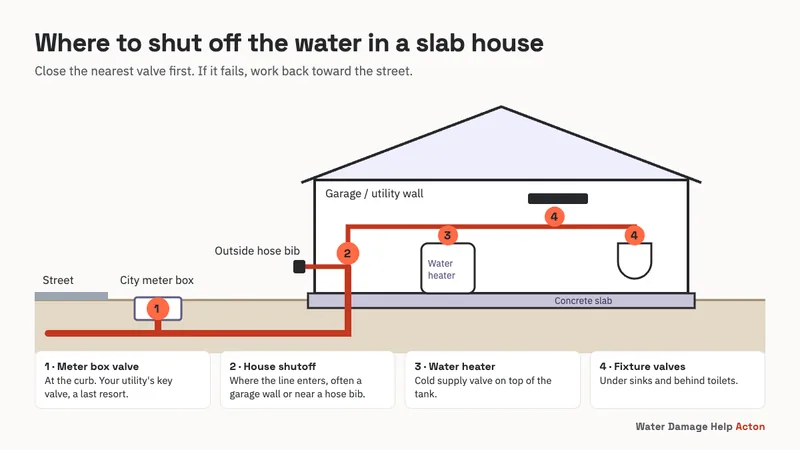
Get the water stopped, because every minute it runs adds to the damage. Close the valve nearest the break. If you cannot tell where the water starts, close the main valve for the whole house, then keep off wet floors around outlets and cords.
- Shut the valve. A fixture has its own stop under the sink or behind the toilet. The house shutoff sits where the supply line enters the home, and the meter has a separate valve that belongs to the water supplier.
- Turn off the breakers for wet rooms, provided you can get to a dry panel without walking through water.
- Open the lowest tap in the house until the flow dies down. That empties the pipes and takes pressure off the break.
- Record the scene with photos and video, covering the break and every wet room, before furniture gets moved.
- Phone a plumber for the repair and your insurer to open a claim.
- Ask for a restoration team to remove the water and begin drying, since this can run alongside the plumbing repair.
If a ceiling below the break is bulging, keep out from under it and read how to drain a wet ceiling safely. For the wider picture of a water emergency, see emergency water damage restoration.
How cold does it get near Acton, and can that split a pipe?
Cold enough to matter. The nearest figures we can cite are for Palmdale, just north. Wikipedia reports about 52 mornings a year at or below freezing there, with normal lows at or near freezing from late November to late January.
Palmdale also gets only about 5.9 inches of rain a year, so a burst here is more often a cold-night problem than a wet-season one. That is a Palmdale record, and an Acton lot in the hills can run colder or warmer than the valley floor.
Ice rarely splits the pipe at the spot where it forms. It blocks the line, the trapped water squeezes toward a closed tap, and the pipe wall fails along that stretch. Water often escapes only after the thaw, so a house can seem fine at dawn and be soaked by lunch.
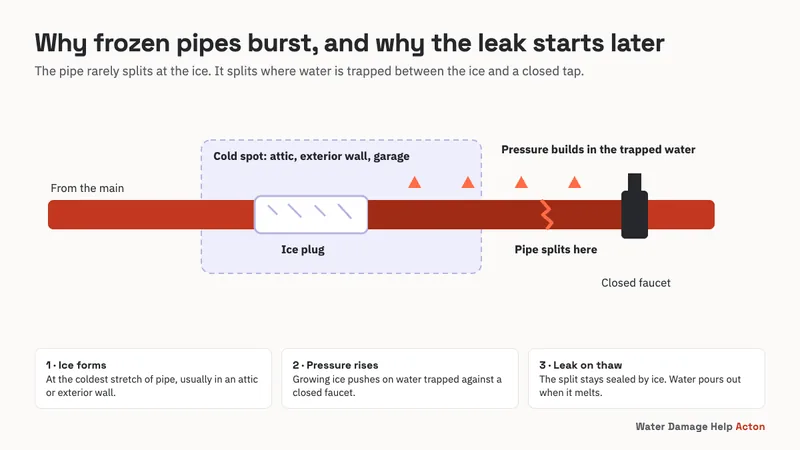
Supply pipes in attics, garages and kitchen cabinets are among the most exposed, according to the Red Cross. Lines on outside walls and hose bibs belong on the same list. Our guide to thawing frozen pipes goes further.
Is it safe to thaw a frozen pipe myself?
Often yes, if the pipe is reachable and has not split yet. Open the faucet first so melting water can escape, then warm the pipe gradually from the tap end. The American Red Cross lists a heating pad, a hair dryer, a space heater kept clear of flammables, or hot wet towels.
- Keep flames away. The Red Cross warns against blowtorches, kerosene or propane heaters and charcoal stoves.
- If the frozen section is inside a wall or under the house, stop and call a plumber instead of guessing.
- If you can already see water, close the main valve before any heat goes near the pipe.
- Keep the tap open after the water starts to flow, and check the pipe for beads of water along its length.
A pipe that thawed without spraying can still hold a hairline crack that only opens under full pressure. After a thaw, walk the house and look for damp drywall, drips and fresh stains on ceilings.
Where do burst pipes usually hide in a house?
They hide wherever a line runs through cold or out of sight. The table pairs the common spots with the first clue and the trade to call. Since Acton homes vary, check which of these spaces your own house has before the cold season starts.
| Spot | Why it fails | First clue | Who to call |
|---|---|---|---|
| Attic or roof-line pipes | Cold air reaches them first on a clear night | A stain on the ceiling below | Plumber, then a restoration team |
| Outside-wall plumbing | Cold passes through the wall and chills the line | Bubbling paint or a damp patch | Plumber |
| Garage or utility room lines | Often unheated, and the pipe is frequently bare | Water pooling on the floor | Plumber |
| Hose bibs and sprinkler lines | Water sits in exposed metal or plastic | Spray or a soaked wall behind the spigot | Plumber or irrigation contractor |
| Lines under a slab or floor | Wear or corrosion, not cold | Warm floor, hissing, a meter that keeps moving | Plumber with leak detection |
Pipe under a concrete floor behaves differently from a freeze burst, and the slab leak page covers it. The signs of water damage guide shows what each room tells you.
Can high water pressure burst a pipe?
It can wear one out over time. A Department of Energy resource, the Building America Solution Center, notes that plumbing codes mostly call for a pressure reducing valve once supply pressure tops 80 psi, because excess pressure can rupture pipes and harm fixtures. Staying at or under 60 psi reduces leaks.
The City of Tustin, California, tells owners the valve is theirs to install and maintain once static pressure reaches 80 psi, and says most plumbing professionals suggest a setting of 35 to 60 psi. A gauge on a hose bib will show your number.
- Repeated knocking or a hammering sound when a valve closes can point to pressure trouble.
- Leaky faucets and a dripping water heater relief line are other signs.
- If your house has a pressure reducing valve, it may only need adjusting. Ask a plumber.
Your water supplier can tell you what pressure it delivers, so call the number printed on your bill if you want that figure.
Who do I call about a leak at the meter or in the street?
Call your water supplier. Whoever sends your bill handles its own main and meter, and the number is printed on it. Your plumber handles everything on the house side, so the first question is which side the water is on.
Closing the house shutoff stops water from entering the home. It does nothing for a leak in the supplier's pipe, which keeps running until the supplier fixes it. If you see water bubbling up near the meter box, photograph it with the date and note the address before you call.
Acton is an unincorporated community, so there is no city hall to phone. If you cannot tell which agency serves your street, the bill is the fastest answer.
How do I find a leak inside a wall or ceiling?
Watch for slow signs that grow over days. A stain that spreads, paint that bubbles, a musty smell and a bill that jumps without any change in use all suggest a hidden leak. Confirm the source before anyone opens a wall.
- Shut off every tap and appliance and read the meter. If the dial keeps turning, water is escaping.
- Look for stains, soft spots and warm patches on ceilings and walls.
- Peek into the attic from the hatch with a flashlight, only if you can see the framing and the floor.
- Ask for a pressure test or leak detection from a plumber rather than cutting blind.
- Ask for moisture readings on suspect surfaces to learn how far the water has spread.
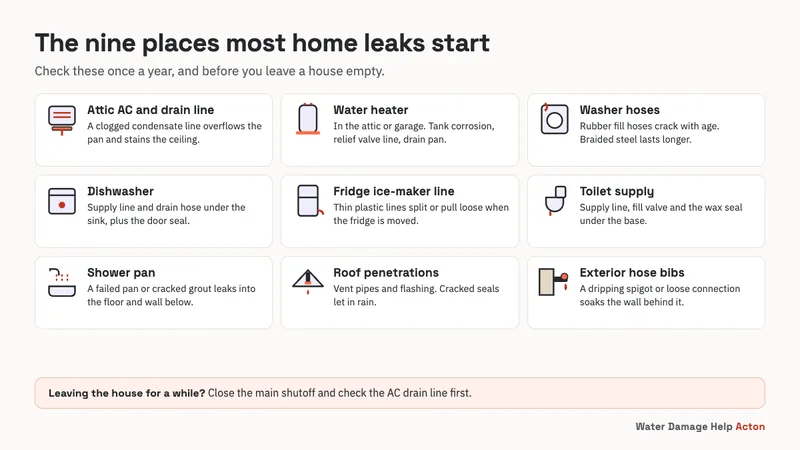
Attic water may come from cooling equipment or a tank instead, so rule those out. The pages on AC leaks and water heater leaks help.
Does homeowners insurance pay for a burst pipe in California?
Often, when the release was sudden and accidental. The California Department of Insurance draws a line between flood, which homeowners policies exclude, and other kinds of water trouble, which they generally include. Your own policy wording has the final say, so read it closely or put the question to your agent.
Standard forms name accidental discharge of water from plumbing as a covered peril, Triple-I reports, and they name freezing of those systems too. NAIC guidance adds that plumbing water damage is typically covered, but ground water and runoff are not.
Neglect is not covered, and mold is often excluded or limited. Arguments tend to center on the pipe repair itself and on leaks that ran for months.
The same department urges owners to stop leaks at the source and report a water claim right away. Our claims guide covers the steps.
How long does my insurer have to respond to a pipe claim?
California regulation sets the clocks. Section 2695.5 of Title 10 of the state code gives an insurer 15 calendar days after notice to acknowledge a claim. When proof of claim arrives, section 2695.7 allows 40 calendar days to accept or deny it, fully or in part.
- An insurer that needs longer must say so in writing inside the 40 days, then repeat that notice every 30 days.
- Payment is due within 30 calendar days of acceptance.
- A denial has to be written, list each reason and point you to the Department of Insurance for review.
Protect the property from more harm, keep your receipts and film the damage, advises Triple-I, but wait on big permanent repairs until the adjuster has seen it. If a claim stalls, call the Department of Insurance consumer line at 1-800-927-4357 or use its complaint page.
How is a house cleaned up and dried after a burst pipe?
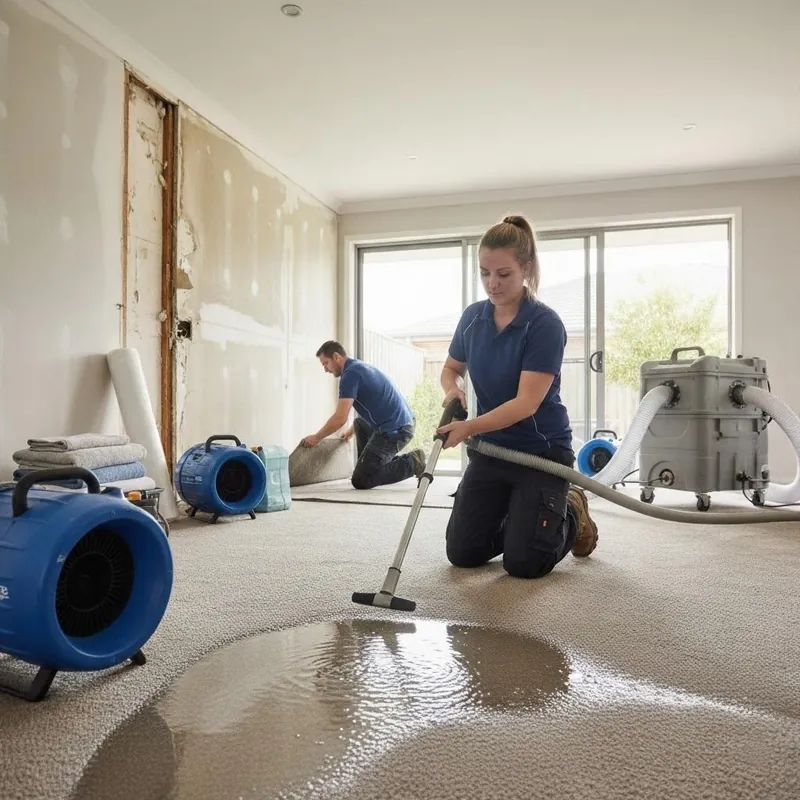
A supply-line burst is usually Category 1, clean water, under the IICRC S500 standard. The category can slip if the water sits or soaks into dirty materials, so the provider checks on site. Drying then follows an order that starts with the source.
- Stop the leak and pull out standing water.
- Remove what cannot be saved, such as soaked insulation, swollen drywall or the pad under carpet.
- Dry the rest with air movers and dehumidifiers.
- Log readings at each visit so progress is visible.
- Rebuild once the materials read dry.
The EPA says materials dried 24 to 48 hours after a leak usually stay mold-free. The water removal and structural drying pages describe each stage, and mold after water damage explains what to do if the area stayed wet. Restoration teams differ in scope, so confirm what each one covers before work starts.
What can I do before winter to protect pipes in Acton?
Wrap exposed lines, keep the house heated and learn where the main valve is. The Red Cross suggests a thermostat setting of at least 55 F when you travel, the same setting day and night, and a slow drip from taps on exposed pipes in a hard freeze.
- Wrap pipes in attics, garages and exterior walls with insulation made for pipes.
- Unhook garden hoses and protect hose bibs before freezing nights start.
- Leave cabinet doors open under sinks on outside walls so warm room air gets to the pipes.
- Turn the main shutoff once to confirm it still works.
The prevention guide adds a checklist for the rest of the year, and choosing a restoration company helps after a break. Ready for help? Contact us to reach a local water damage restoration team.
Sources: IICRC, S500 water categories; EPA, mold and moisture guide; Red Cross, frozen pipe advice; Palmdale climate data, Wikipedia; Building America Solution Center, water pressure; Tustin, California, pressure page; CDI claims guide for homeowners; CDI help and complaints; Section 2695.5, Cornell LII; Section 2695.7, Cornell LII; Triple-I on covered disasters; Triple-I on settling claims; NAIC consumer page on homeowners coverage.