The short version
For sewage backup cleanup in Acton, stop using water, keep people and pets out, and wear gloves and boots if you must touch anything. Sewage is Category 3 water, so soaked porous materials come out and hard surfaces are disinfected. Callers in Acton, Palmdale and north Los Angeles County can call to reach a local restoration team.
What do I do first if sewage comes up in my Acton house?
Stop all water use and keep everyone out of the affected room. Each flush, shower or load of laundry sends more water toward the same blockage, and it escapes at the lowest opening. Once the water is off, call a plumber for the line and a restoration team for the mess.
- Stop using water: no flushing, no faucets, no showers, no dishwasher, no washer.
- Clear the room of children, pets and anyone who has no reason to be near it, and close the door.
- Switch off power to that room at the breaker only if the panel is somewhere dry. If it is not, stay out and call an electrician.
- Photograph the backup and the drain it came from before anything is moved.
- Call your insurer if you carry sewer backup coverage, and note the time of the call.
- Phone a plumber to find and clear the blockage, since cleanup before that can be undone by the next surge.
The cleanup itself is a restoration job. Read about water removal in Acton to see how extraction fits in, and ask each team directly what it handles, because they differ.
Why does sewage come out of the lowest drain in the house?
A backup follows gravity. When the pipe leaving the house is blocked or overloaded, waste water has nowhere to go but up, and it pushes out of the lowest fixture it can reach: a floor drain, a shower, a tub or a toilet on the ground level.
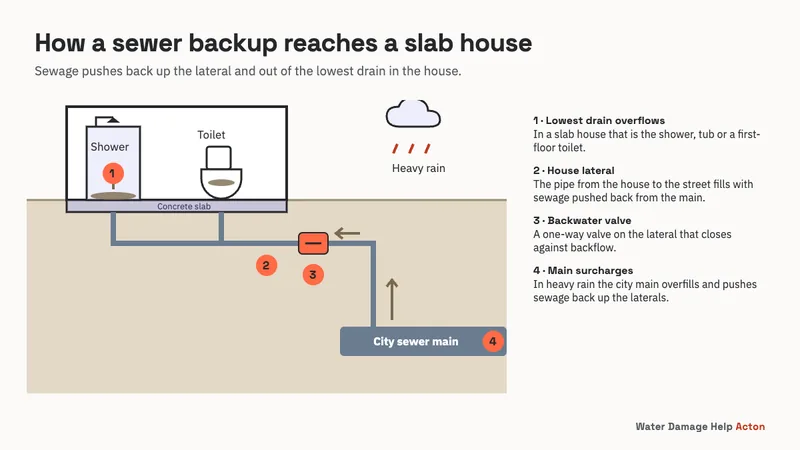
Three kinds of problems are behind most backups:
- A blockage in the private line that runs from the house to the main or tank, from grease, wipes, roots or a broken pipe.
- A problem in the shared main down the street, which can send sewage back toward the lowest connected homes.
- A clog inside the house plumbing, which usually shows up at one fixture, not every drain.
If only one toilet is slow, the cause is probably local. If the shower and a floor drain gurgle at once, the problem is further down the line.
Is sewage Category 3 water, and what difference does that make?
Yes. In the IICRC's S500 standard, sewage sits in Category 3, the grossly contaminated class that also takes in rising river water and runoff from outdoors. Because it brings bacteria and other germs with it, absorbent materials it reaches are generally pulled out, not dried.
When sewage is the culprit, the EPA says to bring in someone with experience in contaminated-water jobs. A mop and a bottle of household cleaner will not reach what has soaked into the framing.
| Water source | IICRC S500 category | What it means for the materials |
|---|---|---|
| Broken supply line or burst pipe | Category 1, clean | Most materials can be dried if the work starts early |
| Washer or dishwasher discharge | Category 2, grey | Clean, disinfect and dry, then judge each material |
| Toilet overflow without waste | Category 2, grey | Same approach as grey water, with a close look at porous items |
| Sewage from a drain or a toilet carrying waste | Category 3 | Soaked porous materials come out, hard surfaces are disinfected |
When you cannot tell which row fits, treat it as Category 3 and wear gloves and boots. The water damage glossary defines all three categories in plain terms.
Is my Acton home on a public sewer or a septic system, and who do I call?
Check your property records or ask your landlord, because the answer decides who responds. The research for this site does not document which Acton homes use sewers and which use septic tanks, so treat it as something to confirm for your own address, not an assumption.
- On a septic system: call a septic service as well as a plumber, since a full or failed tank can push waste into the house.
- On a public sewer: find the cleanout on your property and photograph it. A plumber can tell you whether the blockage is on your side of the connection.
- If neighbors have the same problem: say so when you report it to the sewer operator, because a shared main may be involved.
Ask the plumber for a short written note saying where the blockage was. Your insurer may want it, and so may whoever owns the affected line.
Acton is unincorporated, so Los Angeles County, not a city, is the local government for the area. The Los Angeles County page lists the communities near Acton this site covers.
Who should keep out of the room after a sewage backup?
Anyone who has no job to do there. Some people face more risk than others: those with a weak immune system or a lung condition, older relatives, expecting mothers, small children and anybody with a broken patch of skin. Keep them away until the space is cleaned and fully dry.
- Close the door to keep odor and spray in the room.
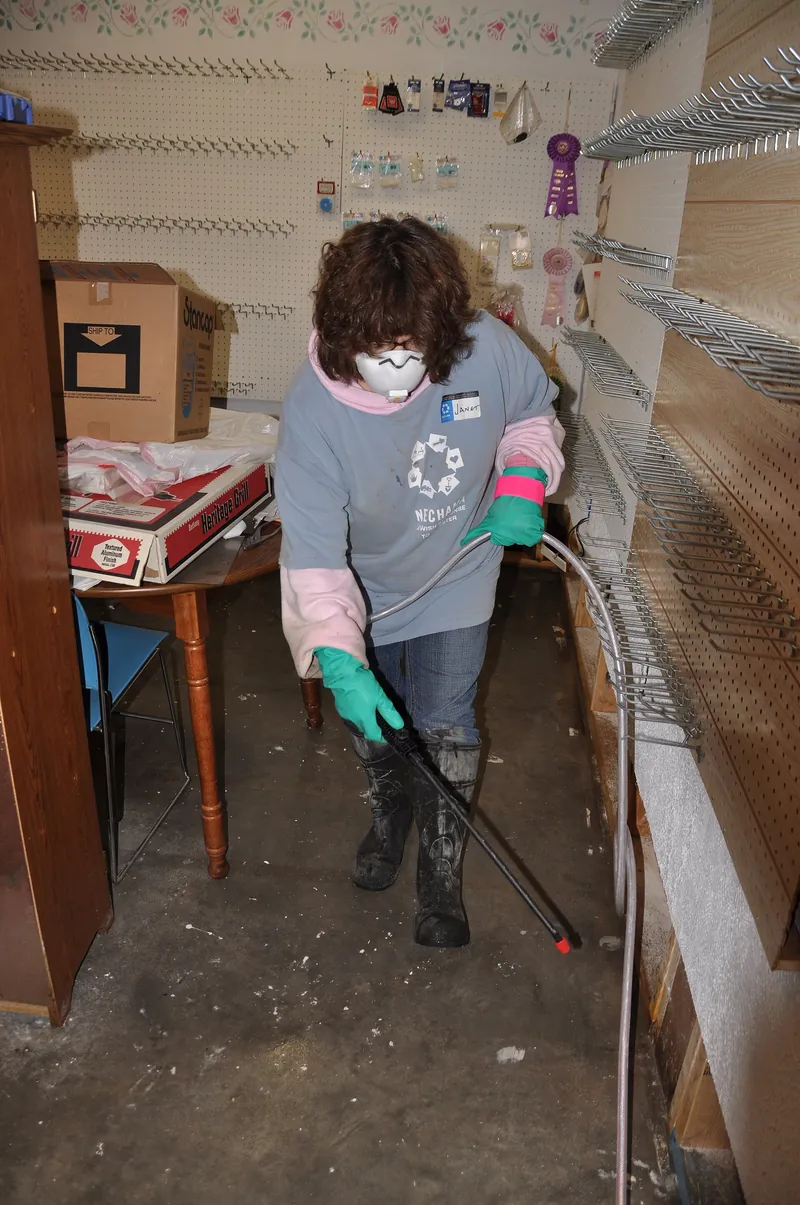
- If you must go in, wear eye protection, waterproof gloves and boots, then wash with soap and clean water afterward.
- Do not eat, drink or smoke in the affected area.
- See a doctor if someone becomes ill after contact, or if a cut touched the water.
On hard surfaces, the CDC names three options: a household cleaner, plain soap and water, or a bleach mix of at most 1 cup per gallon of water. Bleach should never be blended with ammonia or any other product.
Which belongings and materials usually go in the dumpster?
Whatever is absorbent and got wet with sewage. In the room where the drain overflowed, that tends to mean the carpet and its cushion, the bottom stretch of the walls, insulation and soft furnishings. List and photograph each piece first, since that record backs up a claim.
- Wall-to-wall carpet and the pad under it.
- Wallboard and batting wetted by the spill, cut away above the stain line.
- Pressed-wood cabinets and shelving.
- Bedding, area rugs, sofa cushions and plush toys.
- Paper goods, boxed food and any medicine in reach of the water.
Smooth, sealed items such as glass, metal, hard plastic and tile are normally washable and can be disinfected. For solid wood and fabrics that survive a hot wash, ask the provider first. Do not paint or caulk over anything moldy, the EPA adds.
Old homes may hide surprises in the layers under the floor, so see the older home water damage page if yours has several layers of flooring.
How is sewage cleanup done, step by step?
The order is fixed: stop the source, remove the sewage and the contaminated materials, clean and disinfect, dry, then rebuild. The time it takes depends on how far the sewage spread, since a tiled bathroom floor is a smaller job than a carpeted room with wet drywall.
- Clear the line. A plumber or septic service removes the cause so the flow stops.
- Extract and remove. The provider pumps off any pooled sewage and hauls out absorbent materials.
- Wash and disinfect the framing and hard surfaces that remain.
- Dry the space with fans and dehumidifiers until readings return to normal. By the EPA's account, getting wet areas dry inside 24 to 48 hours stops most mold before it starts.
- Rebuild flooring, drywall and trim once everything tests dry.
The page on structural drying in Acton explains how readings are taken. If anything stayed wet longer than two days, read about mold after water damage.
What does sewage cleanup cost?
Only a provider who has seen the damage can quote a real figure. For scale, Fixr reports national water extraction prices per square foot that rise with contamination: clean water $3.75 to $4.25, gray water $4.10 to $6.50 and black water $7 to $7.50. These are national figures, not Acton quotes.
| Water type | Extraction per square foot (Fixr, national) |
|---|---|
| Clean | $3.75 to $4.25 |
| Gray | $4.10 to $6.50 |
| Black (sewage) | $7 to $7.50 |
Extraction is only one line of the bill. Disinfection, haul-away of removed materials, drying and rebuilding are separate, and the plumber charges separately for the line. The restoration cost guide shows the other pieces.
Does California homeowners insurance cover a sewage backup?
Usually not, unless you added it. Per Triple-I, a standard homeowners policy leaves out sewer backups and flood insurance does too; the protection is a separate product or an endorsement. Look through your own declarations and endorsements to see whether you have it.
If you do, report the backup at once. The California Department of Insurance urges policyholders to tell their agent or insurer about water damage claims immediately.
- Insurer duty to acknowledge: California's claims regulations, 10 CCR 2695.5(e), set a limit of 15 calendar days to acknowledge a claim and start investigating.
- Decision window: 10 CCR 2695.7(b) gives the insurer 40 calendar days from proof of claim to accept or deny it, and a denial has to be written.
- Help line: you can reach the Department of Insurance consumer line at 1-800-927-4357.
For the claim file, Triple-I recommends taking photos, keeping receipts and holding on to ruined items until the adjuster looks. The sewer backup coverage page and the insurance claims guide go further.
What if I rent my home in Acton?
Tell your landlord in writing and keep a copy. About 12.0 percent of occupied homes in Acton are renter-occupied, according to 2020 Census figures on Wikipedia, so this is a common situation. California law puts duties on the landlord for plumbing and for dampness.
Civil Code 1941.1 counts working, well-kept plumbing as part of a habitable dwelling. Under Health and Safety Code 17920.3, damp living spaces and visible mold can make a building substandard.
Renters should still photograph their belongings and ask their own insurer whether renters coverage includes sewer backup. The renters and landlords guide covers who pays for what.
How do I keep sewage from backing up again?
Stop grease and wipes at the source, have the line inspected after any backup, and ask a plumber about a backwater valve. That valve lets flow leave the house and closes if sewage tries to come back in. It is a small part, but it can spare a home a repeat of the same mess.
- Put grease in the trash, not the sink.
- Do not flush wipes, including ones sold as flushable.
- Ask for a camera inspection of the private line if you have trees near it or several slow drains.
- If you have a septic tank, ask a septic service how often yours should be pumped.
- Ask whether a permit applies to any valve or line work. See repair permits in Acton.
Fix the line before any rebuilding. A second backup would ruin new flooring and drywall. The prevention guide has a longer list.
How do I choose a provider for Category 3 cleanup?
Ask each team directly whether it takes sewage jobs, what protective gear and disinfection it uses, and what the written scope covers. Restoration teams differ on Category 3 work, and nobody can promise a start time before they see the property.
- Check any contractor's license on the CSLB website before work starts.
- On home improvement jobs, the CSLB consumer guide caps a deposit at $1,000 or 10 percent of the price, whichever is smaller.
- The same guide says to pay as work gets finished, and to put any change in a written change order.
See choosing a restoration company for a longer list of questions. If the water came from outside as well, flood cleanup in Acton covers that case.
Sources: CDI claims guide for residential property; 10 CCR 2695.5; 10 CCR 2695.7; IICRC S500 water categories; EPA on cleaning up mold; EPA on moisture control; CDC mold and health page; Triple-I on covered disasters; Triple-I on settling claims; Fixr cost data; CSLB contract guide; Wikipedia, Acton.