The short version
Water damage repair in Acton, CA replaces what mitigation removed: insulation, drywall, flooring, trim and paint. It begins only when readings show dry framing; the EPA urges drying in the first 24 to 48 hours. Not every provider rebuilds, California sets contractor rules, and Los Angeles County may require a permit.
What does water damage repair cover once the drying is finished?
Water damage repair is the rebuild. After the leak is fixed and the structure has dried, the insulation, drywall, paint, trim and flooring that were torn out get replaced. In Acton, where 88.0% of occupied homes are owner-occupied per the 2020 census, that rebuild is usually the owner's decision and the owner's bill to manage.
Restoration teams vary: some only dry the building, some also rebuild, and some hand the rebuild to a general contractor you choose.
The first phase is described on the water mitigation and structural drying pages. This page starts where those end.
How are mitigation and repair different on paper?
They answer different questions and usually arrive as separate documents. Mitigation asks whether the water is controlled. Repair asks whether the finished rooms look and work the way they did. Many people receive two estimates for one loss, and the table shows why that is normal.
| Mitigation | Repair | |
|---|---|---|
| Goal | Stop the spread and dry what can be dried | Put finished surfaces back |
| Typical items | Water removal, tear-out, fans and dehumidifiers, readings | Insulation, drywall, texture, paint, flooring, cabinets |
| Trigger to start | As soon as the source is stopped and the room is safe | After readings show the framing and sheathing are dry |
| Paperwork | Drying log, equipment days, photographs | Written scope, itemized estimate, change orders |
| Who may do it | A restoration team | That provider's rebuild crew or a contractor you pick |
If a word on an estimate is unfamiliar, the water damage glossary explains it in plain terms.
How do you know the structure is dry enough to rebuild?
Ask to see the readings. A closed wall that is still wet works against the EPA's guidance, which is to get soaked areas and belongings dry in the first 24 to 48 hours so mold does not start. A moisture meter used at the same marked spots every visit gives you numbers instead of opinions.
California's insurance department warns that slow cleanup invites mold. So the dry log deserves as much attention as the estimate. A contractor who wants to close walls but cannot produce that log should be asked why, before work continues.
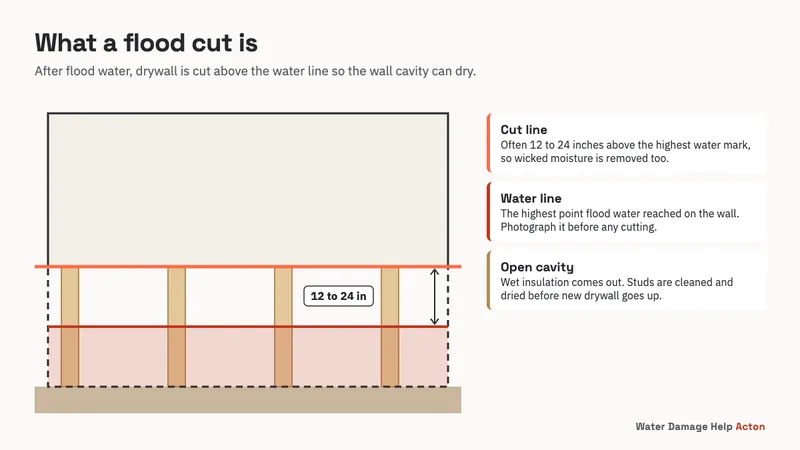
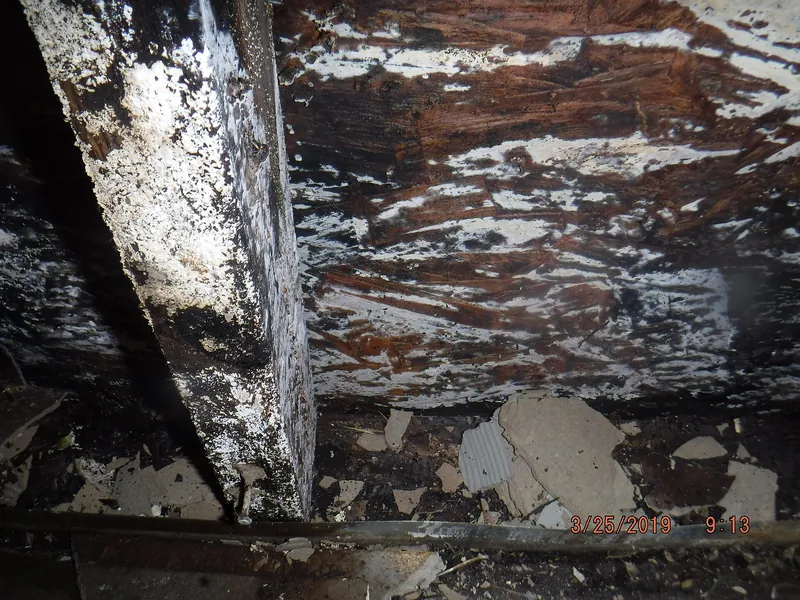
Painting or caulking over mold is something the EPA tells people not to do. Should a wall you thought was dry look stained or smell musty, read mold after water damage before primer goes on.
In what order does a rebuild usually go?
Each trade works on top of the one before, so the order is fairly fixed even when the details change. The sequence starts with the cause of the leak and ends with a walk-through. None of it should begin until dry readings are in hand.
- Fix the cause. Whoever owns the failed part, such as a plumber or roofer, repairs it, or the damage returns.
- Replace insulation in any cavity where it was removed.
- Hang, tape and finish drywall. Drywall water damage repair helps you decide between drying and replacing a wall.
- Prime, texture and paint, usually the full wall so the finish looks even.
- Install baseboard and trim.
- Lay flooring from the bottom up: subfloor, underlayment, then the visible surface. See water damaged floor repair.
- Reinstall cabinets, fixtures and appliances, then walk the job with the contractor.
Carpet follows its own logic on the wet carpet drying page, and stained ceilings are covered under ceiling water damage repair.

What does water damage repair cost, and who sets the price?
Each contractor sets its own price, and this site quotes none for Acton. For scale only: Fixr puts national restoration costs between $1,200 and $5,000, averaging $3,000. Bob Vila, relying on Angi and HomeAdvisor, reports a $1,305 to $5,707 range, and $3,455 on average.
Material drives much of the spread. The table pairs Fixr's per-square-foot ranges with one Bob Vila ceiling range. These are national numbers, not offers.
| Surface | Low end | High end | Unit and source |
|---|---|---|---|
| Drywall | $1.50 | $3 | Square foot, Fixr |
| Carpeting | $4.75 | $10.50 | Square foot, Fixr |
| Plaster | $6.25 | $18.75 | Square foot, Fixr |
| Hardwood | $10 | $15 | Square foot, Fixr |
| Ceiling repair | $350 | $1,250 | Whole job, Bob Vila |
The water damage restoration cost guide explains what moves a total up or down. Older walls can change the math, and water damaged plaster walls are one example.
Who may do the rebuild in California, and what should the contract say?
The Contractors State License Board oversees about 285,000 contractors. Starting January 1, 2025, someone without a license may take a job of $1,000 or less, labor and materials combined, but only when no workers are hired and no building permit is needed. Anything bigger calls for a licensed contractor.
CSLB's consumer guide adds rules worth knowing before you sign anything.
- Down payment: the smaller of $1,000 or one tenth of the price on a home improvement job.
- Progress payments: CSLB says to pay only as work is finished, and to get any change in writing.
- Cancellation: a buyer generally has three business days to cancel, five if 65 or older. A service and repair contract for emergency work you requested on short notice is an exception.
- License check: CSLB runs an online tool at cslb.ca.gov and a line at 800-321-CSLB (2752).
Unlicensed contracting can bring fines of up to $15,000, per CSLB. The guide to choosing a restoration company has a longer set of questions.
Does a repair in Acton need a Los Angeles County permit?
Possibly, and the permitting office decides, not the contractor. Acton is unincorporated, so building permits come from Los Angeles County rather than a city hall. Paint and similar cosmetic work usually differs from structural, electrical or plumbing work, so ask the county before the walls close.
The CSLB point matters here too. A job that needs a permit falls outside the handyperson exemption, so a license in the right classification is required. Ask any contractor in writing who will pull the permit and who pays for it.
Read repair permits in Acton for how to approach the county, and keep copies of whatever is issued.
Should repairs wait for the insurance claim?
Dry the building now and hold permanent repairs until an adjuster has seen it. Triple-I says to protect the property from further harm, keep receipts, and postpone major permanent work until the damage has been assessed. California's insurance department calls temporary repairs that stop more damage among the most important steps.
Keep damaged materials, or photos of them, until the visit is over. Triple-I recommends photos or video and says not to discard damaged items early.
Coverage turns on the cause. The CDI notes that flood is not covered by a homeowners policy but other water damage can be, while the NAIC lists plumbing and roof leaks as typically covered, with ground water and runoff typically left out. Mold is often excluded.
California also sets claim clocks. Section 2695.5(e) of the insurance regulations gives an insurer 15 calendar days to acknowledge a claim, and section 2695.7(b) allows 40 calendar days from proof of claim to accept or deny it. The insurance claims guide shows how those dates fit a repair schedule. The CDI consumer hotline is 1-800-927-4357.
What should you check before signing a repair estimate?
Look for a scope that names the rooms, the materials and what is left out. One lump sum hides gaps. Triple-I suggests collecting written bids from licensed contractors that list each material and price on its own line, so two bids can be compared by scope and not just by total.
- Scope: rooms, square footage, material grade and finish level.
- Exclusions: color changes, putting appliances back, permit fees and hauling debris away.
- Change orders: how surprises behind the wall get priced, with approval on paper.
- Payment schedule: amounts due and when, checked against the CSLB limits above.
- Warranty: what the contractor stands behind, in writing.
Match the estimate to the mitigation paperwork. Each item removed in tear-out should have a rebuild line, and nothing should show up twice. Restoration teams differ on all of this, so confirm each point directly.
Will the new paint and flooring match what was there?
Often not exactly, so raise it early. Paint fades over the years, wall texture varies from one hand to the next, and a flooring line may have been discontinued. A fresh patch beside an older surface can show even when the work itself is sound, and the fix is agreed before work starts.
Whether your insurer pays to match is a policy question, so ask the insurer instead of assuming. These habits help either way:
- Paint: agree to paint wall to corner, not just the patch.
- Texture: approve a small sample before the full wall.
- Flooring: ask what happens if the same product cannot be bought.
- Trim and cabinets: get the stain and profile match written into the estimate.
Why do repairs fail in a high-desert place like Acton?
Most failures trace back to a source that was never fixed, or to walls closed before they were dry. In and around Acton, a cold snap can be that source. Palmdale, next door, has about 52 mornings a year at or below freezing, per Wikipedia's climate summary, and a pipe that split once can split again.
Rain is rare but not harmless. Palmdale averages 5.90 inches a year on about 27 days, so a few wet days can arrive at once. Acton also sits near the point where the upper branches of the Santa Clara River join into one broad wash, which is worth knowing if water ever runs toward a property.
After a wildfire, hillside runoff can carry debris. A February 2025 notice from California's insurance department says policies usually leave out flood, mudslide and debris flow, unless a recent fire or other covered peril set it off. See flooding after a wildfire and how to thaw frozen pipes.
Start with the cause that matches your damage:
- Burst pipe damage, including freeze splits.
- Water heater leaks.
- Roof leaks after a storm.
- AC leaks from a clogged drain line.
If water is still coming in, begin with emergency water damage restoration. To see where requests are taken, browse the service areas or ask for a connection. The wider state picture is at Water Damage Cleanup California.
Sources: EPA mold and moisture guide; EPA home mold cleanup page; CDI residential claims guide; claims rule 2695.5; claims rule 2695.7; CDI February 2025 release; CSLB handyperson release; CSLB contract guide; Fixr cost page; Bob Vila cost article; Triple-I claims advice; NAIC consumer page; Wikipedia, Acton, California; Wikipedia, Palmdale, California; Wikipedia, Santa Clara River.