Quick answer
A slab leak in Acton, CA is a break in a water line under a concrete floor. Clues are a warm floor patch, a hiss with taps closed, a bigger bill and a meter that moves. Close the main valve, call a plumber to locate it, then dry the wet materials. Whether your house has slab plumbing is something to confirm.
How can I tell a slab leak is happening under my floor?
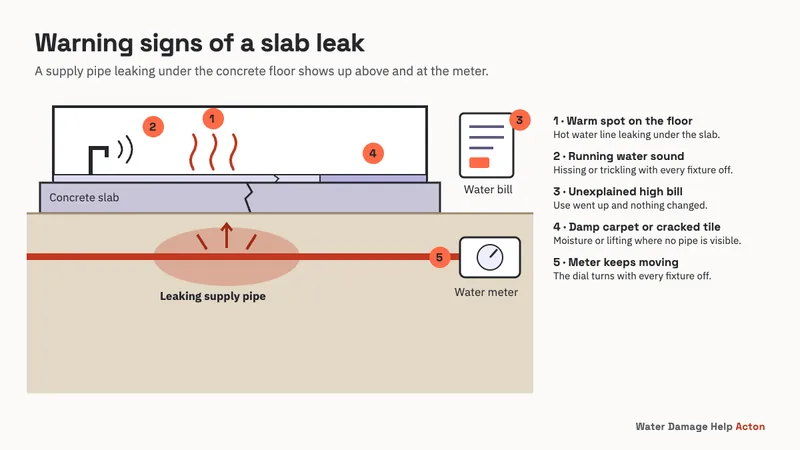
A slab leak is a break in a pressurized water line that runs in or under a concrete floor. You cannot see the pipe, so you read the clues: a floor patch that feels warm, a hiss with every tap closed, a bill that creeps up, or flooring that turns damp for no clear reason.
One clue alone proves little. Two or three at once make a hidden leak much more likely, and that is the moment to call a plumber instead of waiting.
| Clue | What you notice | A less worrying explanation |
|---|---|---|
| Warm spot | One patch of floor stays warm in every season | Sun through a window, a heating duct below |
| Hissing or trickling | A faint sound of water when nothing is running | A toilet that keeps refilling, a worn valve |
| Rising bill | Usage climbs while the household stays the same | Sprinklers, a new habit, a seasonal change |
| Damp or lifting floor | Wet carpet edges, cupped planks, loose tile, a musty smell | An appliance leak or a roof leak elsewhere |
| Spinning meter dial | The dial turns while every fixture is closed | A leaking sprinkler line outside the house |
Does my Acton house have pipes in the slab at all?
That depends on how the house was built, and no source we can cite tells us how homes around Acton are built. Acton has 2,821 housing units, per its 2020 census page, and they were not all built the same way. Ask your plumber or check your plans.
Foundations differ from lot to lot, and so does where the supply lines run. Some houses carry them through the walls and attic, others under a concrete floor, others beneath a raised floor.
- Look for the home inspection or the original plans, which usually name the foundation.
- Ask a plumber where the supply lines enter and which direction they run.
- Check whether a garage or utility room floor shows a seam where the slab was cut for earlier plumbing work.
If your home has a raised floor instead, a leak there is easier to see. The burst pipe page covers lines in walls and attics.
How do I use my water meter to check for a hidden leak?
Close every tap and stop every appliance that uses water, then watch the meter. A dial or small leak indicator that keeps moving means water is escaping from your plumbing. The test cannot say where, only whether you need a plumber.
- Halt all water use. Pause the dishwasher, washer, ice maker and any sprinklers, and make sure nobody flushes.
- Locate the meter box, usually near the street, and photograph the dial.
- Wait a short while, then photograph it again. Any change with everything off points to a leak.
- Shut the house valve and look once more. A stopped dial means the leak is inside the house lines. A dial that still moves means it is on the pipe between meter and house.
- Rule out toilets and the water heater before booking anyone, since a running toilet is the commonest false alarm.
Your water supplier owns the meter, so call the number on your bill if you cannot find it or the dial is hard to read.
How much water can a hidden leak waste?
More than most people expect. EPA's WaterSense program puts the average household's yearly leak loss above 9,300 gallons, and finds that roughly nine percent of homes leak 50 gallons or more per day. A leak under a floor can run for weeks unseen.
Even a faucet is costly. EPA says a drip each second adds up to more than 3,000 gallons in a year.
Those figures cover leaks of every kind, not slab leaks alone. They still show why a rising bill deserves a meter check. Quiet leaks also soak nearby materials, which is where repair cost tends to sit.
A leak that keeps going for months is harder to argue as sudden, a point the insurance claims guide explains. Water can also travel before it surfaces, so the wet spot may sit away from the break.
What should I do first if I suspect the slab is leaking?
Close the main valve, line up a plumber who does leak detection, and protect the floor while you wait. The plumber deals with the pipe. A restoration team deals with the wet materials, and the order matters because drying a floor that keeps getting wet wastes effort.
- Shut the house valve. If you cannot find it, check the garage, a utility closet or the meter box.
- Get belongings off damp floors and raise furniture on blocks.
- Photograph wet spots, the meter dial and your last few bills.
- Phone a plumber and say the meter moves with everything off.
- Notify your insurer. Triple-I suggests protecting the property from more damage while holding off on big permanent repairs until the adjuster has looked.
- Request a restoration team if floors or walls are already wet. The water mitigation page describes that stage.
With the water off and the floor still wet, drying has to start anyway. The signs of water damage guide lists what else to check around the house.
Who finds the leak, and who dries the floor?
A plumber locates and repairs the pipe, often using listening gear or a pressure test. A restoration team does not repair pipes but dries and restores what the water reached. The plumber normally goes first, since drying cannot finish while the source is still open.
- Plumber: tests for the leak, finds the spot and mends or replaces the line.
- Restoration provider: pulls out standing water and ruined material, dries the building and logs moisture.
- Flooring or drywall contractor: rebuilds once readings show dry.
- Insurer: decides what the policy pays, usually after an adjuster has seen the damage.
Methods differ between companies, so ask each one what it does. California's contractor board, CSLB, says unlicensed people may take small jobs of up to $1,000 only when no workers are hired and no permit is needed, which is why you check a license first.
Opening a slab or a wall can trigger a permit. Acton is unincorporated, so building permits come from Los Angeles County. The restoration company guide lists questions to ask.
Is a spot repair or a reroute the better fix?
It depends on the pipe and its leak history. A spot repair opens the floor over the break and mends that section. A reroute retires the line and runs new pipe through walls or the attic, and only a plumber who has tested the line can recommend one.
| Approach | What it involves | Trade-off |
|---|---|---|
| Spot repair | Cut into the floor at the break and replace that stretch of pipe | Less work for a single leak, but other weak points on the line remain |
| Reroute | Cap the old line and run new pipe overhead or through walls | Leaves the floor mostly intact, but opens walls and adds patching and paint |
Never accept a phone price before a diagnosis, and ask for a written scope. Costs vary, so this site quotes none. For what drives restoration bills, read the restoration cost guide.
How does a leak under concrete damage floors and walls?
Water rises through cracks and joints in the concrete and wets the underside of flooring first, then the base of the walls. The damage often stays out of sight for a while, so the harm can be larger than the stain implies. Different finishes react differently.
- Carpet and pad: hold water, and the pad is normally replaced. See wet carpet drying.
- Hardwood and laminate: cup, buckle and gap, and planks on a wet slab resist drying in place. See water-damaged floor repair.
- Tile: may loosen or crack when the bedding below stays soaked.
- Baseboards and drywall: wick water upward, so the lower section often has to be cut out.
- Cabinet bases: particleboard swells and seldom bounces back.
Ask the provider to measure the slab, the floor and the lower wall, and to explain the readings.
How is a floor dried once the pipe is fixed?
Drying begins after the plumber stops the leak. The provider takes out wet flooring and padding, opens the lower wall if needed, and sets air movers and dehumidifiers. Concrete holds moisture and releases it slowly, so readings are repeated across several visits.
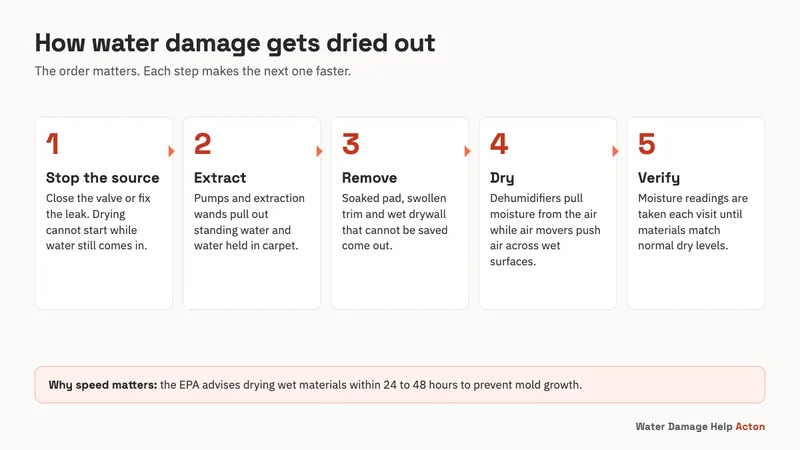
A slab can feel dry on top while still holding water below. New flooring laid too soon can trap that moisture and invite mold. Ask for a written moisture log, and hold the flooring contractor back until readings reach the dry reference points the provider sets.
The structural drying page explains the equipment and the monitoring.
Can mold grow under the flooring after a slab leak?
Yes, when materials stay wet. The EPA says that if damp materials are dried within 24 to 48 hours of a leak, mold usually will not grow. A hidden leak is often found later than that, so the undersides of carpet, pad and baseboards are at real risk.
- Smell: a musty odor near a floor or wall, with nothing visible, is a warning sign.
- Humidity: aim for 30 to 50 percent indoors and stay under 60, per EPA.
- Size: a patch smaller than roughly 10 square feet is usually a do-it-yourself job, EPA notes. Hidden or bigger growth needs a professional.
- Surface rule: EPA says never paint or caulk over mold.
California has no state license for mold assessors or remediators, according to the Department of Public Health, so ask any company about training and references. The mold after water damage guide goes deeper.
Does California homeowners insurance cover a slab leak?
Sometimes. The state insurance department separates flood, which homeowners policies exclude, from other water damage, which they generally cover, and it tells owners to stop leaks at the source. Whether a hidden pipe leak qualifies turns on your wording and on how long the leak ran.
Triple-I lists accidental discharge from plumbing as a covered peril on standard forms. It also says policies exclude damage from poor maintenance, and the NAIC says homeowners policies often exclude mold. A slow leak found late can run into both limits.
The California FAIR Plan is different. The Department of Insurance describes it as a bare-bones policy covering fire and smoke, and says water damage is not among the perils it offers. Check which policy you hold.
Insurers have deadlines too. Under section 2695.5 of the state regulations, an insurer has 15 calendar days to acknowledge a claim, and section 2695.7 allows 40 calendar days once proof of claim arrives to accept or deny. The complaint page shows how to ask the department for help.
How can I catch a hidden leak early?
Check the meter on a schedule and watch the bill. Both cost nothing and both catch leaks long before a floor fails. The Department of Energy's Building America Solution Center adds that pressure above 60 psi raises the odds of leaks and ruptures, and codes call for a reducing valve above 80 psi.
- Learn where the main valve is and confirm it turns.
- Read the meter before a trip and again on return. A change means water moved.
- Compare each bill with the last one and look into any jump you cannot explain.
- Walk the floors barefoot once in a while and note any patch that is warm for no reason.
- Ask a plumber to test pressure at a hose bib, and to fit or adjust a reducing valve if needed.
See the prevention guide for habits that apply year round, and the water heater leak page for another common source. When you are ready, contact us to reach a local water damage restoration team.
Sources: EPA, leak facts from Fix a Leak Week; EPA, moisture and mold brief; DOE Building America Solution Center, service water pressure; Acton, California, census page; CSLB press release on the handyperson limit; CDPH mold questions and answers; CDI homeowners claims guide; CDI statement on the FAIR Plan; CDI help and complaints; Section 2695.5; Section 2695.7; NAIC, consumer homeowners page; Triple-I, claims after a disaster; Triple-I, disaster coverage.