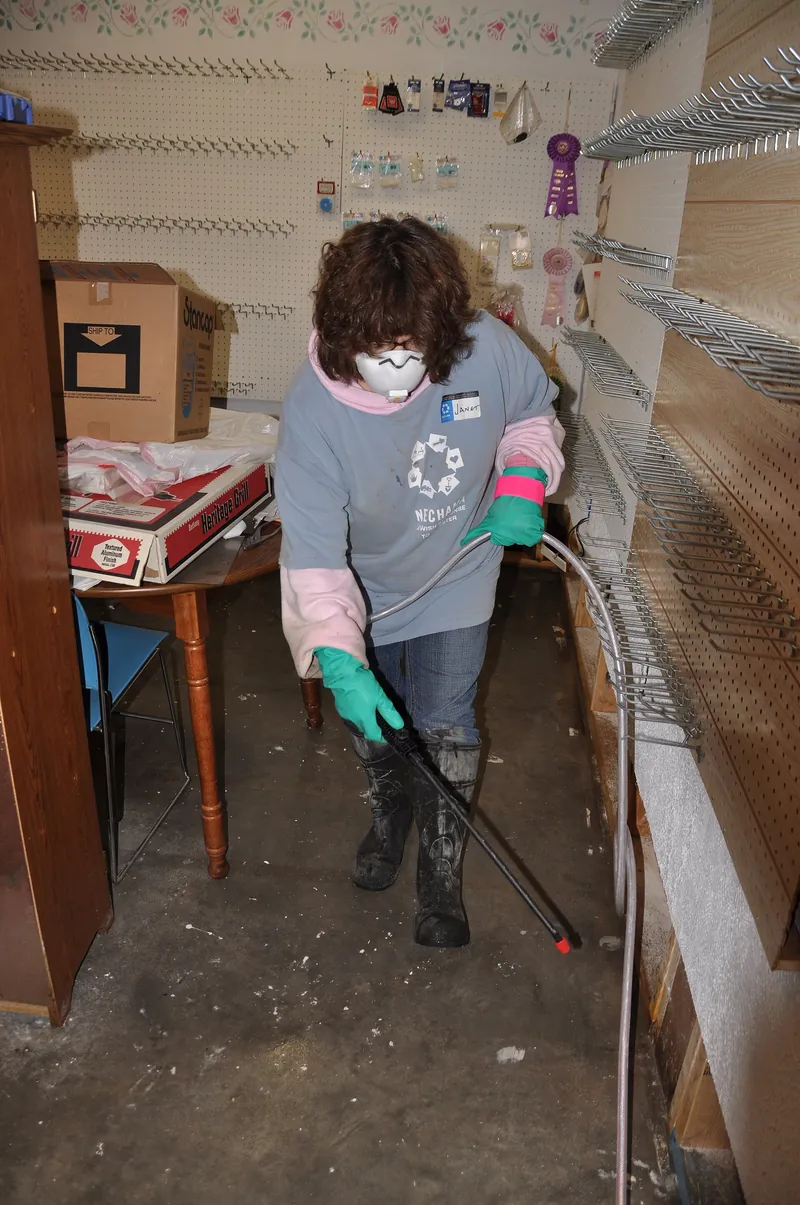
The short version
Flood cleanup in Acton, near Palmdale in north Los Angeles County, means removing soaked porous materials, cleaning what stays and drying the structure before rebuilding. California homeowners policies exclude flood, so a flood loss usually needs a separate flood policy.
What does flood cleanup in Acton involve?
Flood cleanup in Acton means getting outside water, silt and ruined materials out of a building, then washing, drying and repairing it. Water from a street, slope or wash picks up dirt and contaminants on the way in, so the job is bigger than a mop and a few fans. It ends when the structure tests dry.
People in Acton and nearby Palmdale can call to reach a local water damage restoration team. Each team decides its own scope and terms. Read on to learn how flood work usually runs so you can weigh what you are offered.
The source of the water is what separates a flood from a pipe leak. A supply line spills clean water. Runoff does not, so more of the house gets opened and more of it gets disinfected before drying even starts.
How does flood water reach a home near Acton?
Usually as quick runoff from a storm or a slope rather than a slow river rise. Wikipedia places Acton between the Sierra Pelona and San Gabriel Mountains, and says the upper branches of the Santa Clara River merge into a wide wash close to the community.
Rain arrives in short bursts. Wikipedia's climate normals for neighboring Palmdale list 5.90 inches a year over only 27 days. NOAA notes that across the west coast states, a few atmospheric river storms can deliver 30 to 50 percent of a year's precipitation.
Los Angeles County Public Works operates the county's flood control system, Wikipedia reports. Its Los Angeles article notes that several rainy days in a row can flood low ground and send mud down hillsides, particularly where wildfire has stripped the vegetation.
None of these sources names an Acton street that floods. Look up your own address on FEMA's flood map and ask the county. A failed hose or water line is a different kind of loss, covered on water removal and extraction.
Is it safe to go back into a flooded house?
Wait until the water has stopped rising, the power to the wet rooms is off and you have checked for hazards. Moving water is the first danger: Ready.gov reports that six inches can knock an adult over and a foot can carry a car away.
- Switch off the breakers for flooded rooms from a dry spot, or call an electrician.
- Smell gas? Get outside and phone the gas utility from there.
- Watch for sagging ceilings, spongy floors and walls that have moved.
- Put on boots, gloves and goggles. Mud holds whatever the water collected on its way.
The CDC recommends that same gear and open windows while you work. If the water rose through a drain, treat it as sewage and read sewage backup cleanup first.
Why is flood water called Category 3?
The IICRC S500 standard files rising water from rivers, streams and outdoor surface flow under Category 3, the grossly contaminated class that also holds sewage. Outside water crosses soil, roads and yards before it gets to you, so nobody can treat it as clean. That label steers most of the decisions that follow.
In practice, porous materials that Category 3 water reached usually come out instead of drying in place, and hard surfaces get cleaned and disinfected first. Ask any provider which category they picked and why.
When sewage or other dirty water caused the damage, the EPA tells owners to hire someone experienced with that kind of building loss. That is a good reason not to take on a whole flood job alone.
What are the steps of flood cleanup and restoration?
The common order is document, pump, tear out, clean, dry, then verify dryness before any wall is closed. Providers sequence these differently, so get their plan in writing before work begins and ask what each step is meant to accomplish.
- Document. Photograph the water mark in every room and each damaged item before anything is moved.
- Pump and extract. Standing water and silt leave floors and low spots.
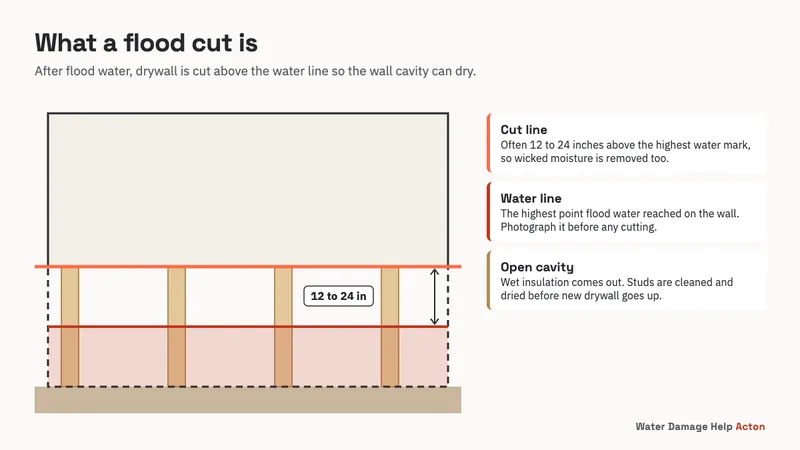
- Tear out. A flood cut takes off drywall above the water mark so wet insulation can be pulled and studs can air out.
- Clean and disinfect. Framing, subfloor and the items that stay are washed and treated.
- Dry. Air movers and dehumidifiers run until readings match dry reference spots. See structural drying.
- Verify. Boxing in damp framing is how hidden mold starts.
Rebuilding follows drying: drywall, insulation, flooring and paint. That stage is covered on drywall water damage repair.
Which belongings and materials can be saved?
Hard, non-porous things can usually be cleaned and kept, while soaked porous things usually cannot. The CDC advises discarding carpet and upholstery that were drenched and cannot be dried quickly. Take a photo of each piece first, since an adjuster will want to see what was lost.
| Item | Often cleaned and kept | Often thrown out |
|---|---|---|
| Floors | Sealed tile, concrete | Carpet, pad, laminate |
| Walls | Wood framing, masonry | Drywall and insulation below the cut |
| Furniture | Metal, glass, solid pieces | Upholstery, particleboard |
| Kitchen and bath | Dishes, hard plastic | Food, medicine, soft goods |
For hard surfaces the CDC lists household cleaner with water, or at most 1 cup of bleach per gallon of water, and warns against ever combining bleach with ammonia.
Have a qualified technician check any appliance or electrical item that sat in water before you plug it in. A provider can sort, photograph and box up belongings, as described on contents cleaning and pack-out. On a claim, you and the adjuster decide what is kept.
How quickly must a flooded home dry to stop mold?
Aim for 24 to 48 hours. The EPA gives that window for drying wet areas and belongings, and the CDC uses it for flooded homes. Humidity counts too: the EPA wants indoor humidity kept below 60 percent, and best between 30 and 50.
A humidity meter runs $10 to $50, the EPA says, which makes it an inexpensive check on a room you are drying. Ask the provider how it will keep indoor air dry, and leave walls open until the framing and subfloor read low.
- The EPA warns against painting or caulking over mold.
- The CDC says mold can hit people with asthma or mold allergy hard and can lead to lung infections in immune-compromised people.
- CDPH says California has no state licensing for mold remediators, so ask how a provider was trained.
More detail is on mold after water damage.
Does cleanup change when burned slopes sit above a home?
Yes, since burned hillsides send down mud and rock as well as water. A USGS paper on Montecito tells of a downpour on ground the Thomas Fire had burned, which moved roughly 680,000 cubic meters of sediment and left 23 dead and 408 homes damaged. That was Santa Barbara County, not Acton, but the pattern applies.
Debris flows leave heavy silt and stone in and around a building, so hauling material out may come before pumping. Ask a provider whether it has the gear and how it would handle that.
Insurance shifts as well. A 2025 release from the California insurance department notes that flood, mudslide and debris flow are typically excluded from homeowners and commercial policies, with an exception when a recent wildfire or another covered peril is the trigger. Flooding after a wildfire goes deeper.
Does insurance pay for flood cleanup in California?
Normally not through a standard homeowners policy. Per the California Department of Insurance, those policies omit flood yet still respond to other water damage, so flood protection has to be bought on its own. FEMA makes the same point about most homeowners policies.
| Water source | Standard homeowners | Where cover comes from |
|---|---|---|
| Rising water or runoff | Excluded | Separate flood policy |
| Sewer or drain backup | Not typically covered | Added endorsement or product |
| Plumbing leak inside | Typically covered | Your homeowners policy |
Triple-I also reports that sewer backup is left out of typical homeowners cover and of flood insurance alike. The NAIC says ground water and rain runoff usually fall outside cover. Earthquake policies do not fill the gap, because CDI states they exclude flood and sewer or drain backup.
CDI also says a new flood policy takes effect 30 days after purchase, except for certain borrowers whose federally regulated lender requires it. Buying one as a storm approaches generally comes too late.
What deadlines apply to a California flood claim?
Under the state's claim regulations an insurer has 15 calendar days from notice to acknowledge a claim, then 40 calendar days from proof of claim to decide. Report the loss, then document everything before cleaning. CDI does not regulate the NFIP, so these deadlines may not govern an NFIP claim.
- Report the loss and note the claim number.
- Photograph and film each room, the water mark and every item.
- Limit further damage and save every receipt. Triple-I advises waiting on big permanent repairs until the adjuster has assessed the loss.
- Hold on to damaged items until the adjuster has come by.
- Collect written bids that price materials line by line.
For an NFIP claim, CDI lists 1-800-638-6620. For trouble with a state-regulated insurer, its consumer hotline is 1-800-927-4357. The insurance claims guide covers more.
Is there help if the flood was not insured?
Sometimes. Federal help applies only when a declared disaster includes individual assistance for your county, and you apply through DisasterAssistance.gov. It covers basic needs and does not stand in for insurance. Declarations are announced rather than automatic, so follow county and FEMA notices after a big storm.
Keep the provider's photos, readings and invoices with your records. An insurer or a disaster agency may ask for them later.
Apply even while an insurance decision is pending, and save every letter. Paperwork showing the water mark, the materials removed and the drying readings helps explain what the flood did to the building.
Do you need a permit to rebuild after flood damage in Acton?
Possibly. Acton is unincorporated, so permits come from Los Angeles County Public Works, Building and Safety, not a city office. Cleanup and drying often need none, while structural repairs, electrical work and some replacements can. Call the county before work starts, not after.
A provider can say what it plans to pull permits for, though each one has its own practice. The repair permits guide lists what to ask the county.
File any permit paperwork with your claim records. If the building sits in a flood hazard area, the county may add rebuilding rules of its own, so raise that on the call.
What should you ask a flood cleanup provider before agreeing?
Ask which water category they assigned, what is coming out and why, how they will prove the structure is dry, and what the written scope includes. This site cannot speak for any provider, and they differ on each point, so confirm directly before work begins.
- Do you photograph walls and floors first?
- What readings mark the job as finished?
- Is the quote itemized, and what might change it?
- Who talks to the insurer if it pays less than the bill?
CSLB's consumer guide caps a home improvement deposit at the lesser of $1,000 or 10 percent of the contract price, and says payments should track completed work. It also says unlicensed work up to $1,000 is allowed only with no hired workers and no permits, so a larger flood job calls for a licensed contractor.
The guide to choosing a restoration company goes further. For a flooded shop or office, see commercial water damage. To ask for a connection, use the contact page.
Sources: Wikipedia on Acton; Wikipedia on the Santa Clara River; Wikipedia on Palmdale; Wikipedia on Los Angeles County; Wikipedia on Los Angeles; NOAA Research on atmospheric rivers; Ready.gov flood page; IICRC S500 overview; CDC mold and health page; EPA moisture guide; EPA mold cleanup page; CDPH mold questions; USGS Montecito paper; CDI press release on mudslide cover; CDI property claims guide; CDI earthquake brochure; CDI flood facts; Regulation 2695.5; Regulation 2695.7; Triple-I, disaster coverage; Triple-I, claim settlement; NAIC consumer page; FEMA flood insurance FAQ; DisasterAssistance.gov; CSLB contract guide; CSLB handyperson release.