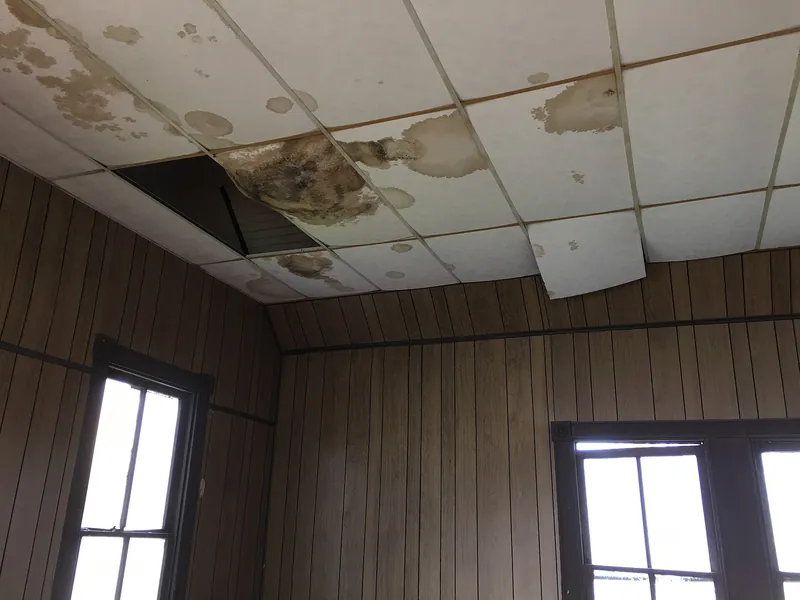
Quick answer
Ceiling water damage in Acton, CA starts with power off in the room and a bucket under the lowest point of any bulge, which you open from the side. After that, trace the source by timing. Board that turns soft or droops is normally replaced.
What do I do when water is dripping or bulging through the ceiling?
Start by making the room safe. Turn off breakers for nearby lights and outlets, empty the floor below, and let trapped water escape from the lowest point of a bulge. Soaked drywall is heavy and can fall without warning, so work from the side and avoid a large sag.
- Flip the breakers that feed any light, fan or outlet in or under the wet area.
- Clear the floor of furniture, rugs and electronics, then spread a tarp or old towels.
- Put a bucket beneath the lowest part of the bulge.
- Puncture the bulge at its lowest spot with a screwdriver, standing to one side, so water runs into the bucket.
- Stop what is feeding it. If a pipe or fixture above is the source, close its valve or the main valve.
- Photograph the damage before cleanup and tell your insurer.
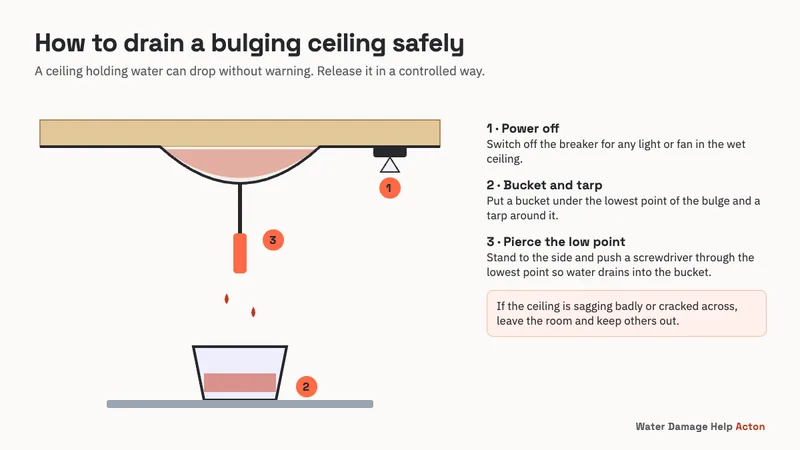
If the water comes from a split supply line, the burst pipe page explains the shutoff steps. Once the water stops, water damage repair describes what the rebuild involves.
How do I know the ceiling is about to come down?
Failure usually announces itself. Watch for a bulge that keeps growing, spreading cracks, lifting joint tape, screw heads showing through paint, or a spot that feels spongy. Any of these means people and pets should leave the room right away, and nobody should stand under the sagging spot to look at it.
- You can hear or see water moving inside a swollen patch.
- New cracks follow seams or circle a light or fan.
- Water drips from several points at once.
- Paint or texture has blistered and hangs in a sheet.
Drain only a small bulge yourself. If a whole panel droops or splits, shut the door, cut power to the room and get help.
Is the stain from an old leak or one that is still active?
An active leak leaves a cool, damp stain that is darkest in the middle and keeps growing for days. An old one is dry, with a hard tan edge that stays put. Several nested rings show the leak has come back more than once.
- Press lightly beside the stain. A sponge-like give means moisture remains.
- Draw the outline in pencil and look again after the next shower, storm or cooling cycle. A stain that crosses the line is fed by a live leak.
- Borrow a meter, or ask a provider for a reading.
Prime and paint only a dry stain whose cause is fixed. A fresh one means water still gets in, so trace it first. Other rooms show different clues, which the signs of water damage guide sorts out.
Where is the water above my ceiling coming from?
Notice exactly when the dripping starts. The timing points to the source before anyone cuts into drywall, and water travels along joists and wires, so the stain can sit far from the real leak. The table pairs common patterns with the trade that usually handles them.
| Pattern | Likely source | Trade |
|---|---|---|
| Appears only during or after rain | Roof covering, flashing, a vent boot or a window above | Roofer |
| Grows while the cooling runs | Clogged condensate line or a full pan under an air handler | HVAC technician |
| Follows a shower upstairs | Shower pan, tub overflow, grout or a drain seal | Plumber |
| Follows a flush | A toilet seal or supply line above | Plumber |
| Near a tank in the attic or upper floor | Tank, fittings or the relief line | Plumber |
| Steady day and night | A pressurized supply line or fitting | Plumber, with the main valve closed |
Even a one-story house has an attic over every ceiling, so roof and attic equipment account for many stains.
Why would an air handler soak the ceiling below it?
A cooling system pulls moisture from the air and sends it away through a condensate line. If that line clogs, the water backs into a pan, and a pan that overflows or rusts through drops water onto the ceiling. These leaks follow the cooling cycle, so the stain grows only while the system runs.
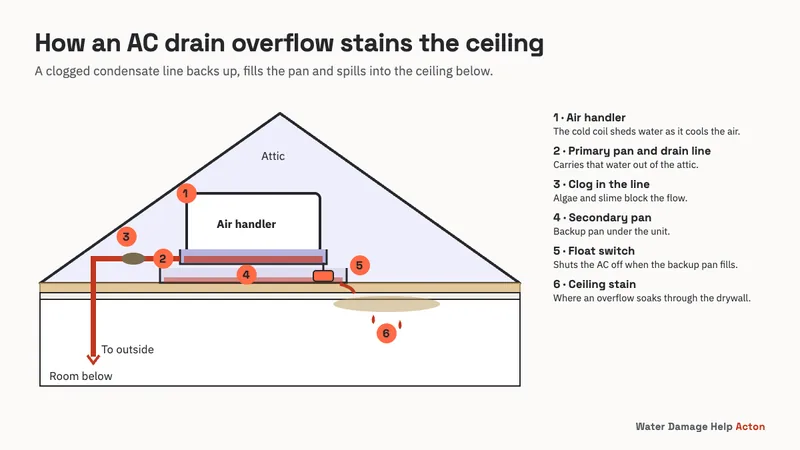
According to ENERGY STAR, a plugged drain can damage the house and push up indoor humidity, and a contractor's annual checkup includes inspecting it. A float switch in the pan can stop the system before it spills.
If you see water dripping from the unit, turn it off and call an HVAC technician. Drying the ceiling will not help while the line stays blocked. The AC leak page has more.
Can a water heater above the ceiling leak through it?
Yes. A tank above living space can saturate insulation and drywall long before a drip appears. A drain pan catches small leaks if its outlet leads somewhere safe, so look for rust trails, a damp pan or wet insulation around the base.
- With an active leak, shut the cold water valve on top of the tank.
- Set a gas unit's control to off, or switch off an electric unit's breaker.
- California requires residential water heaters to be braced against earthquake motion under Health and Safety Code 19211, so a loose tank is a second reason to call a plumber.
The plumber mends or swaps the tank, while a restoration team deals with wet insulation and ceiling board. Our water heater leak page gives the shutoff order.
Does a rainstorm near Acton mean a roof leak?
It can. Rain finds gaps at flashing, vent boots, chimneys and worn roofing, soaks the insulation and then shows up as a stain a few feet from the opening. A stain that appears only during or after rain points at the roof, not the plumbing.
Rain is scarce nearby, which can hide a problem. Palmdale averages about 5.9 inches a year on about 27 days, according to Wikipedia, so a roof can go many dry weeks between tests. The first storm of the season often reveals what summer concealed.
The roofer closes the opening, and ceiling drying only pays off once nothing more can enter. See roof leak and storm damage for the full sequence.
Can a stained ceiling be saved, or does it have to go?
Sometimes. A modest stain from clean water can often be dried and repainted, but drywall that has turned soft, sagged or crumbled has lost its strength and gets cut out. The deciding factors are how long it stayed wet and what the water carried.
- Light stain, brief clean leak: dry, prime with a stain blocker, repaint.
- Board that is soft or crumbling: swap it for new.
- Soaked insulation overhead: it keeps water against the framing, so it normally comes out.
- Ceiling tiles: the EPA says porous materials such as ceiling tiles may need to be thrown away if they become moldy.
Before closing up or painting, have the board and framing checked with a moisture meter. Coating damp drywall traps the moisture and the stain comes back.
When does the drywall have to be cut out?
Drywall is removed when it is soft, drooping, stained all the way through, or hiding wet insulation that has no other way to dry. The contamination level matters as much as appearance, and the IICRC S500 standard sorts water into three categories.
| Condition | Usual approach | Reason |
|---|---|---|
| Dry ring from a fixed leak | Prime and paint | The board is sound and the source is gone |
| Damp but firm, clean water | Dry where it hangs, then verify with a meter | Firm board can often recover |
| Soft, sagging or cracked | Cut out and replace | Saturated gypsum weakens for good |
| Wet insulation behind it | Open the ceiling, remove insulation, dry framing | Trapped water keeps the cavity wet |
| Sewage or outside surface water | Remove affected material | IICRC S500 calls it Category 3, grossly contaminated |
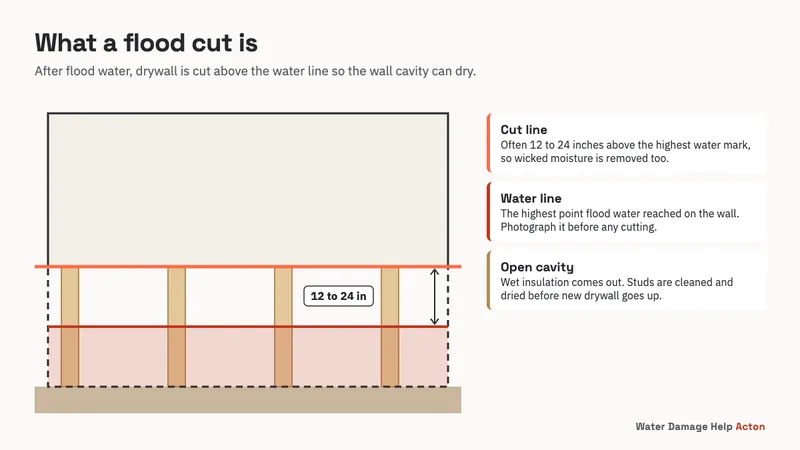
Under IICRC S500, supply-line water is Category 1 and washer or dishwasher water is Category 2. The drywall repair page explains cut lines and drying.
Will mold show up on the ceiling after a leak?
It can if the material stays wet. The EPA ties mold prevention to drying within 24 to 48 hours and to indoor humidity under 60 percent, ideally 30 to 50. Attic leaks are a particular risk because nobody sees them for days.
Once a stain appears, inspect the insulation surface and the roof deck from below. Take a musty smell seriously even if nothing is visible.
The EPA says most people can clean a moldy area under about 10 square feet and should never paint or caulk over mold. For sewage or other contaminated water it advises calling a professional. The mold guide has more.
Will insurance pay for the ceiling and the leak behind it?
Often, depending on the cause. The NAIC says a leak in the roof or in a home's own plumbing is typically covered, while ground water and runoff are not. The California Department of Insurance gives rain through a roof hole as an example, if a covered event made the hole.
- Triple-I lists accidental discharge from plumbing, heating, cooling or an appliance among named perils.
- Triple-I also says policies exclude damage from lack of maintenance, so a worn roof can be disputed.
- The NAIC notes mold is often excluded.
Under section 2695.5 of the state regulations an insurer has 15 calendar days to acknowledge a claim, and section 2695.7 gives it 40 calendar days from proof of claim to accept or deny. Photograph the damage and wait for the adjuster before big permanent repairs. The claims guide has the steps.
What if I rent and the ceiling is leaking?
Tell the landlord in writing and keep a copy. California Civil Code 1941.1 names roof and exterior wall waterproofing, and plumbing kept in good working order, among the basics of a habitable dwelling. Health and Safety Code 17920.3 treats dampness of habitable rooms as a substandard condition.
Photograph the ceiling over several days, and move belongings out from under it. Your renters policy may cover your things even when the building is the landlord's. The renters and landlords guide covers the details.
When should I call a restoration team?
Call when the ceiling sags, the insulation above is soaked, water has reached walls or floors, or the leak ran for more than a few hours. Restoration teams differ in what they handle and how fast they can come, so confirm directly. Acton is unincorporated, so any permit would come from Los Angeles County.
- Have the leak stopped, by you or by the right trade.
- Film and photograph the ceiling and any soaked belongings.
- Find out if moisture is measured at the start and the finish of drying.
- Learn which materials would come out and which would be dried where they are.
- Get the work described in writing first.
The guide to choosing a company lists more questions. When you are ready, contact us to reach a local water damage restoration team.
Sources: IICRC, S500 water categories; EPA, moisture and mold brief; EPA, cleaning up mold; ENERGY STAR, maintenance checklist; Palmdale climate data, Wikipedia; Health and Safety Code 19211, Seismic Safety Commission; CDI claims guide for homeowners; Section 2695.5; Section 2695.7; NAIC, consumer homeowners page; Triple-I, disaster coverage; CDPH, dampness and mold booklet for renters.