The short version
Facing a water heater leak in Acton, CA? Close the cold water valve at the tank, cut the electricity or gas, take photos, then phone a plumber for the heater and request a restoration team for the water. Aim to begin drying inside 24 to 48 hours.
What should I shut off first when a water heater is leaking?
Stop the water feeding the tank, then cut the heater's power or fuel. A water heater leak in Acton, CA can keep pouring for a while from a full tank, so keep out of standing water near outlets and cords until the electricity is off.
- Close the cold water inlet valve on the pipe at the top of the tank. If it is stuck, shut the main valve for the whole house.
- Flip the breaker for an electric heater, but only from a dry spot where you are not standing in water.
- On a gas unit, turn the control knob to off. If you notice a gas smell, get outside first and phone 911 or the gas utility.
- Take photos of the tank, its label and each wet surface before any cleanup begins.
- Phone a plumber to diagnose the leak and fix or replace the unit.
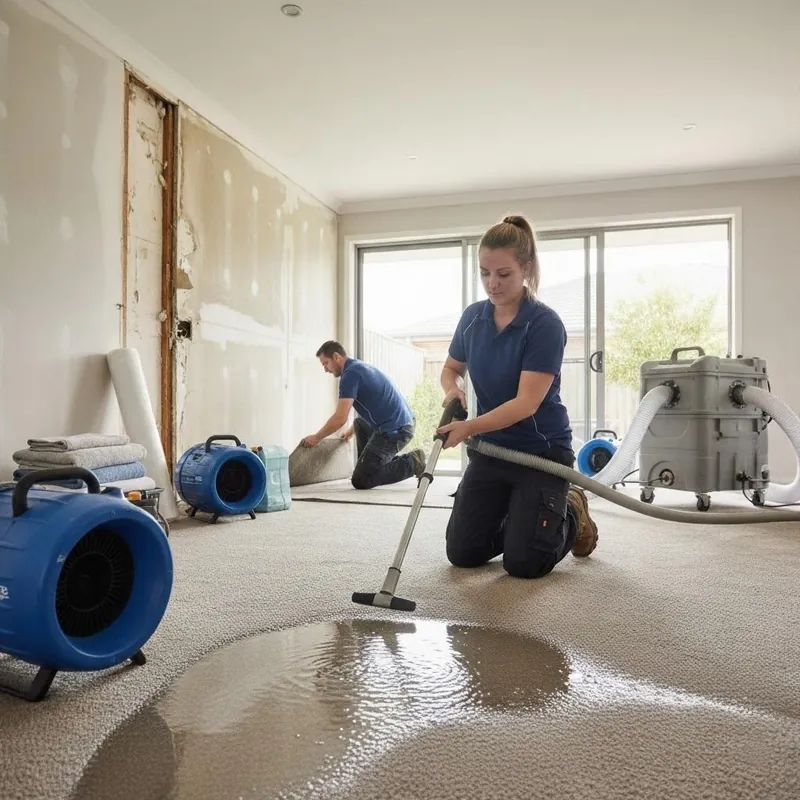
- Request a restoration team to pull out the water and dry the building.
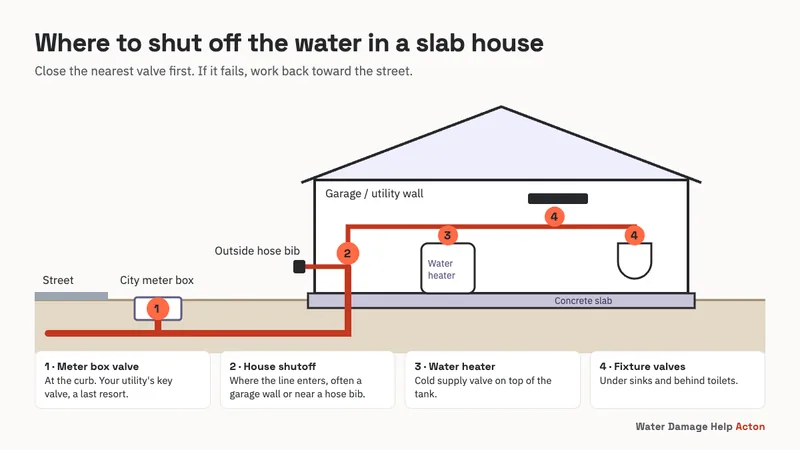
Our page on water removal in Acton explains how standing water is taken out. If the tank emptied into a ceiling, read about ceiling water damage repair before anyone pokes at the drywall.
What makes a tank water heater leak?
A tank heater leaks when a part wears out, a fitting works loose or pressure builds inside the tank. The spot where water appears is the best clue to the cause. The table pairs each spot with a likely cause, a safe check you can do and the person who usually fixes it.
| Where the water shows | Likely cause | Safe check | Who to call |
|---|---|---|---|
| Beads of water on the pipes above the tank | Worn or loose inlet and outlet connections | Close the inlet valve and watch whether the dripping stops | Plumber |
| A wet, rusty tank wall or a steady trickle from the shell | Corrosion has opened the tank itself | Look for rust streaks running down the metal | Plumber, usually for a replacement |
| Water leaving the discharge pipe beside the tank | The relief valve is opening, or the valve is worn | Note when it drips and whether it happens while the heater is heating | Plumber |
| A puddle at the drain valve near the floor | A drain valve that is loose, worn or not fully closed | Check that the handle is turned all the way shut | Plumber |
| Water on the floor while the tank is dry | A nearby supply line, appliance or air conditioner drain | Follow the wet path back to its highest point | Plumber or air conditioning technician |
When water seeps through the steel shell, the tank has worn out, and patching it is rarely realistic. Ask the plumber to tell you plainly whether you have a bad tank or just a bad fitting, since that answer drives the cost and the timeline.
What does California require for water heater bracing?
Under Health and Safety Code section 19211(a), every residential water heater in the state, whether new, replacement or already installed, must be held down with straps, anchors or bracing so a quake cannot tip or shift it. A heater that shifts can strain the pipes attached to it, which is one more way a tank ends up leaking.
A bracing guide from the Division of the State Architect, dated 2004, describes a minimum of two sets of straps for typical residential tanks. Because that document is old, ask your plumber to check what the present California Plumbing Code requires for your tank.
Subsection (b) also requires a seller to confirm in writing that the heater was secured. That matters if you are buying or selling, and the guide to disclosing water damage when selling covers the paperwork side. On its earthquake insurance page, the state insurance department counts a wall-braced heater among retrofits that may lower premiums.
Does a dripping relief valve mean something is wrong?
A relief valve is a safety part, so a drip or a burst of water from its pipe is a message to act on. It can mean pressure or temperature inside the tank climbed too high, or that the valve itself has worn out. Never cap or plug it.
The Department of Energy's Building America guidance explains one common trigger. Once a pressure reducing valve is installed, the plumbing becomes a closed system, and heating the water can raise pressure in some cases. A plumber can test the pressure and tell you whether an expansion tank or a new valve is the answer.
- Write down when the valve drips, such as only after a long shower or all day.
- Place a bucket under the discharge pipe, never a cap over its end.
- Tell the plumber what you saw so the diagnosis starts with facts.
Can high water pressure make a water heater leak?
Yes, it can shorten the life of a heater and the pipes around it. The Department of Energy's guidance says pressure above the usual limits can rupture pipes and damage fixtures, and that keeping it at or below 60 psi reduces leaks in faucets, water heaters and hoses.
The City of Tustin, in a public guide, says most plumbing codes call for a pressure reducing valve when static pressure goes above 80 psi, and that most plumbing professionals recommend a setting between 35 and 60 psi. Tustin is not Acton, so use those figures as a reference and ask a plumber to read the gauge at your house.
A pressure gauge screws onto a hose bib, and a plumber can take the same reading. If yours is high, ask whether a reducing valve is already installed and only needs adjusting.
Can cold nights in the Antelope Valley cause a water heater problem?
They can strain pipes that run through cold spaces. Palmdale, next door to Acton, has normal minimum temperatures at or just below freezing from late November to late January, and about 52 mornings a year at or below freezing, according to its climate record on Wikipedia.
The Red Cross names supply pipes in unheated spaces, such as attics, garages and kitchen cabinets, as the ones most likely to freeze. If a pipe feeding or leaving your heater runs through an exposed space, it deserves a look before a hard freeze. The page on thawing frozen pipes explains how to warm one safely, and burst pipe water damage covers what follows a split.
Wikipedia describes Acton's own summers as warm and dry, with no monthly average above 71.6 F, so winter nights are the season to plan for. I do not have a freeze count for Acton itself, only for Palmdale.
What if the tank leaks onto a ceiling or wall below?
Water follows gravity and framing, so a heater above living space can soak a ceiling and run down a wall. Stay out from under a bulging ceiling, because it may be holding water that can come down all at once. Keep the power off to any fixtures in the wet area.
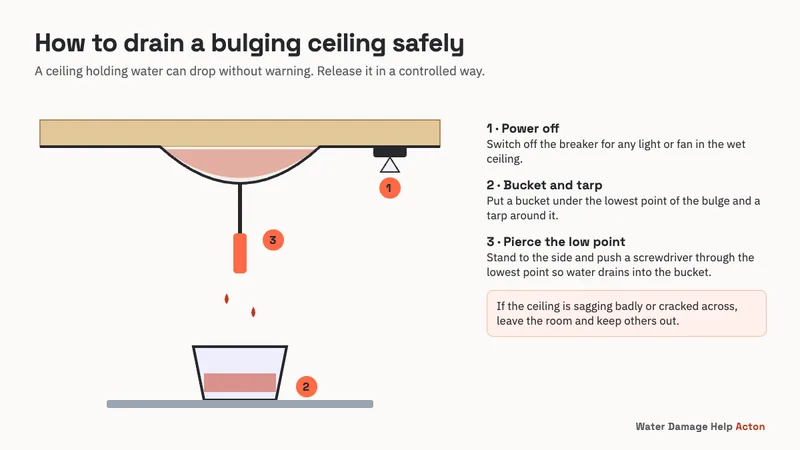
IICRC S500 treats water from a supply line as Category 1, clean water, though that can change if it sits or soaks into dirty materials. The restoration team you reach confirms the category once the water is stopped, and the drywall water damage page explains what happens to wet wallboard.
Does homeowners insurance cover a water heater leak in California?
Often the water damage is covered, but the policy and the cause decide. Triple-I reports that typical policy forms list sudden leaks and overflows from plumbing, heating systems and appliances as covered causes, and NAIC says plumbing leak damage is typically covered. Neither tells you how your own insurer will treat a worn-out tank.
- Triple-I adds that damage from poor upkeep is not covered, so keep service records.
- Report the loss promptly. The state insurance department urges homeowners to stop the leak at its source and to tell their agent or insurer about water damage right away.
- California rules give insurers 15 calendar days to acknowledge a claim (10 CCR 2695.5(e)) and 40 calendar days from proof of claim to decide (10 CCR 2695.7(b)).
- Keep receipts and hold off discarding damaged items until the adjuster has looked, as Triple-I advises.
The water damage insurance claims guide walks through the steps, and the CDI consumer line, 1-800-927-4357, takes complaints about claim handling.
What if I rent and the water heater leaks?
Tell your landlord in writing right away and keep a copy. California Civil Code 1941.1 lists plumbing in good working order among the features a rental home must have, and a leaking heater is a plumbing failure. A renter's own policy may help with belongings.
The 2020 census counted 2,821 housing units in Acton, and 12.0% of occupied homes were renter-occupied, so this question is common enough to plan for. Photograph the leak, the wet belongings and your message to the landlord. The renters and landlords guide explains who handles what, and why the repair and the drying are usually separate calls.
How is the water from a heater leak dried?
A restoration team finds where the water traveled, removes standing water, takes out materials that cannot dry, and then runs drying equipment while tracking moisture readings. The EPA's guidance is to get wet areas and belongings dry inside 24 to 48 hours, which is the window in which mold usually does not take hold.
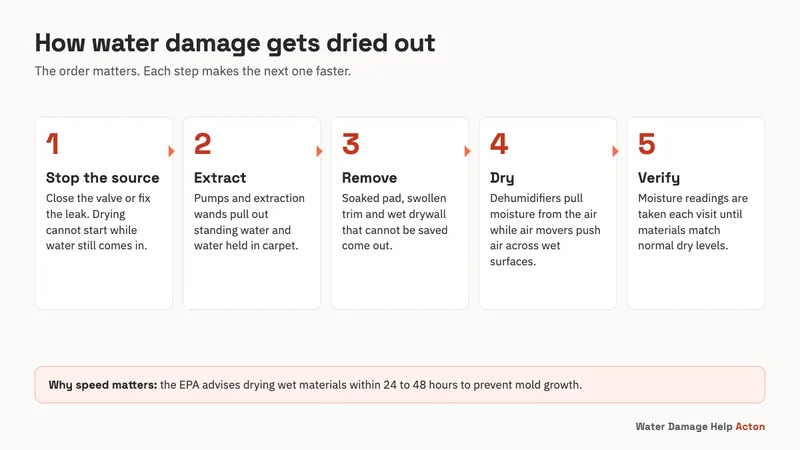
The IICRC S500 standard puts the job of locating and correcting the water source on the owner, not on the restorer. That is why you need two calls, one to a plumber and one to a provider, and why you should confirm what each one does. The pages on water mitigation and structural drying explain each step.
How can I keep a water heater from leaking again?
Inspect the heater on a routine and retire it before it fails. Rust, dampness at the base and a dripping relief valve are the warning signs, and a clear, well-lit space around the tank makes a small leak easy to spot.
- Find the inlet valve now and confirm it turns freely.
- Glance at the tank, the pipes and any drain pan for damp spots whenever you pass.
- Ask a plumber about flushing sediment and testing the relief valve during upkeep.
- Have the water pressure read, and ask about a reducing valve if it is high.
- Confirm the straps that brace the tank are in place and snug.
- Put a leak sensor or an automatic shutoff valve under a heater that sits over living space.
The water damage prevention guide adds a full checklist, and signs of water damage helps you catch a hidden leak early. Acton is unincorporated, so ask Los Angeles County Public Works, Building and Safety, whether a replacement needs a permit, and see the repair permits page. Statewide background lives on the California water damage site.
Sources: state insurance department claims guide; 10 CCR 2695.5 and 2695.7; HSC 19211 on the Seismic Safety Commission site; State Architect bracing guide; earthquake insurance page; Building America service water pressure; Tustin water pressure page; Palmdale on Wikipedia; Acton on Wikipedia; Red Cross on frozen pipes; the S500 standard; EPA moisture guide; Triple-I on covered disasters; Triple-I on settling claims; NAIC consumer page.