The short version
AC leak water damage in Acton usually traces to a clogged condensate drain that overflows the pan. Switch the system off, catch the water and call an HVAC technician. Wet insulation and drywall should be dried within 24 to 48 hours to avoid mold. Callers in Acton and Palmdale can call to reach a local restoration team.
Why is water coming from my air conditioner in Acton?
Most often the condensate drain is blocked. An air conditioner pulls moisture out of the indoor air while it cools, and that water is meant to flow away through a small drain line. When the line clogs, the pan under the coil fills and spills onto whatever sits beneath the unit.
ENERGY STAR warns that a drain left plugged can damage the house and push indoor humidity up. Acton summers are dry, with no monthly average above 71.6 F according to Wikipedia, but a system that runs for long stretches still makes water.
| Likely cause | What you see | Who usually handles it |
|---|---|---|
| Blocked drain line | Water in the pan, a damp ceiling or wall near the unit | An HVAC technician |
| Rusted or cracked pan | Drips even though the line flows freely | An HVAC technician |
| Iced-over coil | Weak airflow, frost, then a rush of water on melting | An HVAC technician |
| Sweating duct or line | Beads of water on cold metal, soggy wrap | An HVAC technician |
| Soaked ceiling or wall | Stains, sag, soft spots, a musty odor | A restoration team, then a repair contractor |
The drying that follows a leak is described on the water mitigation page.
What do I do in the first few minutes of an AC leak?
Turn the system off at the thermostat, and at its breaker if you can reach that safely. A running unit keeps producing water. Next, catch the drips, protect whatever sits below, and call an HVAC technician to find out why it is leaking.
- Shut the system off at the thermostat, then the breaker if the panel is dry and close by.
- Stay out of any crawl space or attic that has standing water or soggy insulation near wiring.
- Put towels and buckets under the drips and move furniture away from the wet patch.
- Look up. If the ceiling bulges with water, read how to drain a ceiling safely.
- Take photos of the pan, the stain and the water before you wipe anything.
- Phone an HVAC company for the unit, and a restoration team if insulation or drywall is wet.
Keep the unit off until the drain is cleared. Running it again only refills the pan.
How does a clogged drain line turn into a ceiling stain?
Slime, algae and dust slowly narrow the drain until water stops moving. That is how a minor maintenance gap becomes a damp ceiling. It backs up into the pan, rises over the rim and drips onto the structure under the air handler. Whatever is under the unit takes the water.
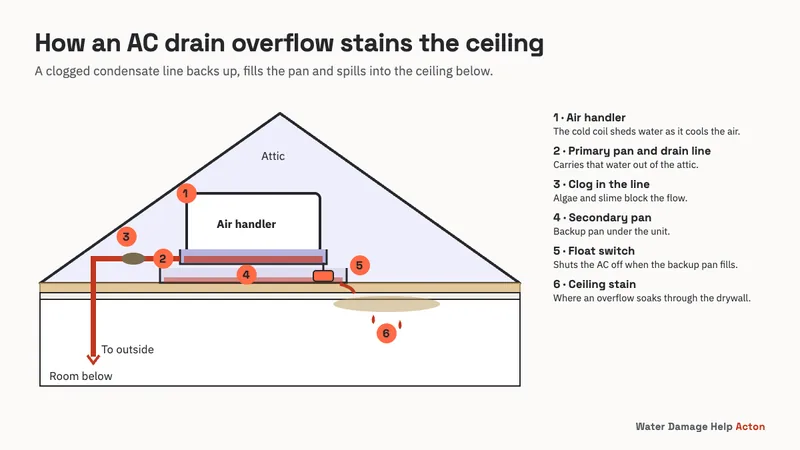
That drain is typically a slim plastic pipe, which is why it clogs so readily. A technician can clear it and tell you which upkeep is safe for you to do yourself.
ENERGY STAR notes that a typical annual check-up includes inspecting the condensate drain, and suggests the cooling system is best checked in spring. It also recommends checking or changing the air filter once a month.
Which parts are meant to stop a small clog from becoming a flood?
Three parts: a drain pan under the coil, a backup pan or outlet, and a float switch that cuts power when water rises. Whether your home has them depends on when and how the system was installed, so ask the installer or an HVAC company.
- Primary pan: catches water from the coil and sends it down the line.
- Backup pan or second outlet: water showing up there means the main drain has failed.
- Float switch: stops the system when the pan fills. A missing or stuck switch lets the overflow continue.
Confirm directly with any company what it can add. The prevention guide covers other devices that limit leak damage.
How can I tell whether the water is from the AC or somewhere else?
Pay attention to timing and location. Condensate is cool and clear and appears while the system runs. Water that keeps coming after the unit is off may be a pipe, and water that appears only after rain may be a roof problem.
- Only while cooling: the drain, the pan or a frozen coil.
- Warm water or a steady flow: look at supply lines and the water heater.
- After a storm only: see roof leaks and storm damage.
- Beads on a cold duct or line: condensation, not a split pipe.
The signs of water damage guide helps separate a one-time overflow from a slow drip.
What does an AC leak do to insulation and drywall?
Water soaks insulation first, then the drywall behind or below it. A drain that overflows now and then leaves a ring that returns after each episode. A steady leak softens the board until it sags, and the damage usually reaches farther than the stain.
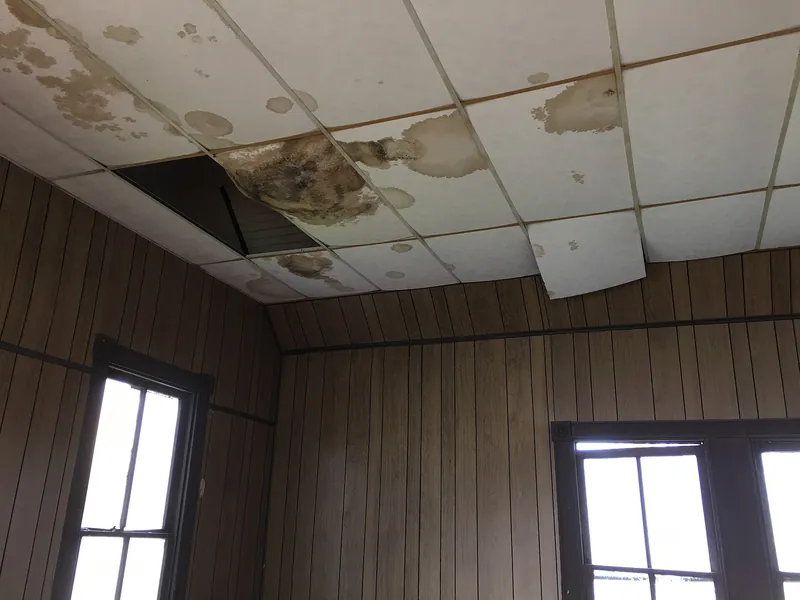

- Insulation: once wet it holds water against the board and should be assessed for replacement.
- Drywall: stained, soft or sagging board usually has to come down.
- Paint: stains bleed through new paint until the source is fixed.
- Wiring and fixtures: keep power off to a wet ceiling.
For repairs after drying, see drywall water damage repair. Bob Vila reports a national range of $350 to $1,250 for ceiling repair, which is a rough guide only.
Is sweating on a duct or cold pipe the same thing as a leak?
No, though the damage can look alike. Cold metal collects moisture when warmer, humid air touches it. The cure is usually insulation or sealing, not a drain repair, and an HVAC technician can tell the two apart in one visit.
Moisture beading on pipes and walls, the EPA explains, points to high humidity, and wrapping cold water pipes in insulation is one of its fixes.
- Torn or missing duct wrap lets cold metal sweat.
- Gaps around the unit let humid air reach cold parts.
- Bare cold lines drip along their whole length.
Methods differ between companies, so ask what each one checks.
Can a leaking air conditioner lead to mold?
Yes, if wet materials stay wet. The EPA says that drying wet or damp materials within 24 to 48 hours usually keeps mold from growing. A leak above a ceiling can go unseen for days, so insulation and the back of the board are common trouble spots.
The EPA also names ductwork and the top of ceiling tiles among places where hidden mold can grow.
- Humidity: the EPA suggests keeping it under 60 percent, ideally 30 to 50 percent.
- Small patches: under about 10 square feet is usually a job most people can handle, says the EPA.
- Larger or hidden growth: bring in a professional, and do not paint or caulk over it.
The mold guide explains when to call for help.
Will California homeowners insurance pay for AC leak damage?
Often it pays for the resulting water damage but not for fixing the air conditioner itself. Standard forms name accidental discharge or overflow from plumbing, heating and cooling systems as covered perils, Triple-I explains. Neglect and mold are treated differently.
Damage blamed on poor upkeep is left out of policies, Triple-I adds, and the NAIC notes that mold is frequently excluded. A drain nobody ever serviced could be argued as neglect, so read your wording closely.
- California's Department of Insurance wants water damage claims reported right away.
- While you wait, Triple-I suggests protecting the home, saving receipts and keeping ruined items for the adjuster.
- The claims rule at 10 CCR 2695.7(b) sets forty calendar days from proof of claim for the insurer's decision.
The claims guide walks through the full process.
Where is my air handler, and what sits underneath it?
Find out before a leak, because the answer tells you what a spill will reach. This site's research does not document how homes in Acton are built or where systems are installed, so look at your own property or ask the person who services it.
The question matters because an air handler can sit over living space, beside a wall or above stored belongings. Water follows gravity and then spreads along framing, so the wet area is often larger than the first spot you notice.
- Note which rooms lie directly below or beside the unit.
- Keep boxes, electronics and papers off the floor beneath it.
- Make sure you can reach the thermostat and breaker quickly.
- Ask the technician where the drain line ends and whether you can see that end.
If the unit is a rooftop or outdoor model, the damage path is different, so see roof leak and storm damage for how water travels from above.
Is AC leak water clean, and does cold weather change anything?
Condensate starts out as clean water, a Category 1 source under IICRC S500 terms, but it can pick up dirt and growth from the pan, the line and the materials it soaks. Water that sits for days should be treated with more caution than a fresh spill.
Cooling season is not the only time to watch. Palmdale, next door, sees about 52 freezing mornings a year, according to Wikipedia, so a system that sits idle in spring or fall can collect dust and slime before it runs hard again.
- Fresh, clear water: usually handled by drying the area quickly.
- Old, stained or smelly water: ask the provider how it should be treated.
- Winter leaks near heating equipment: a frozen pipe may be the source, so read how to thaw frozen pipes.
A technician can tell condensate from supply water by checking the system, and a moisture reading shows how far the damp has spread.
Who fixes what: HVAC technician, plumber or restoration team?
Each handles a different layer. The HVAC technician fixes the equipment, a plumber handles supply or drain pipes that are not part of the unit, and a restoration team dries and removes whatever got wet. Sequence matters, because drying first can be undone by a leak that is still running.
- Stop the source: the HVAC company clears the drain and checks the pan and switch.
- Dry what is wet: a restoration team measures moisture and sets up drying.
- Repair: a contractor replaces insulation, drywall and paint once readings are normal.
Restoration teams differ in what they take on, so confirm directly. On the repair side, CSLB says an unlicensed person may do small projects up to $1,000 only if no workers are hired and no permits are needed, and that figure covers labor and materials. See choosing a restoration company.
How do I keep the drain from overflowing again?
Have the line cleared on a schedule, test the float switch and watch for early warning signs. These small habits cost far less than a ceiling repair, and most of them are routine service items that any HVAC company knows.
- Add drain clearing to the yearly service visit, ideally before cooling season.
- Ask about a float switch on the pan and whether yours is working.
- Change the filter as often as ENERGY STAR advises, since restricted airflow can ice the coil.
- Glance at the backup pan or outlet when you can do so safely.
- Insulate bare cold lines and re-wrap torn ducts.
Stains can also come from appliances, so see the appliance leak page for other usual suspects.
Sources: ENERGY STAR maintenance checklist; EPA on moisture control; Triple-I on covered disasters; Triple-I on settling claims; NAIC homeowners page; CDI claims guide for residential property; 10 CCR 2695.7; Bob Vila cost article; Wikipedia, Acton; Wikipedia, Palmdale; IICRC S500 water categories; CSLB handyperson release.