The short version
For a home in Acton, the only published yardstick is national: the 2025 Fixr figures run from $1,200 to $5,000, averaging $3,000. Dirtier water, a larger wet area and more soaked material push a bid up. Request written bids that itemize every charge, and confirm terms with each provider directly.
What does water damage restoration cost, and is Acton priced differently?
No published survey prices Acton jobs, so the honest answer is a national range, and a wide one. Fixr reports a spread from $1,200 up to $5,000 and a typical job near $3,000. Bob Vila, drawing on Angi and HomeAdvisor, lands slightly higher: $1,305 to $5,707, averaging $3,455.
Both are nationwide averages across many kinds of loss. A damp hallway and a soaked living room sit in the same range, which is why the spread is so wide. Neither number is a quote for a home in Acton, and this site does not set prices.
Restoration teams set their own rates and their own terms for rural addresses. Use the national figures to test whether a written bid is plausible for the work it lists, then ask the provider to explain anything that looks far outside the range.
How does the type of water change the price?
Dirtier water costs more to remove, because workers need protective gear and more of the wet material has to be thrown out. Fixr prices extraction per square foot by water type. The IICRC S500 standard sorts water into three categories based on contamination, not on how much spilled.
| Dollars per sq ft, extraction | IICRC category | Where the water usually starts |
|---|---|---|
| $7 to $7.50 | Category 3, black water | Sewage, a flooded river or stream, surface water from outdoors |
| $4.10 to $6.50 | Category 2, gray water | Washer or dishwasher discharge, a toilet overflow that carries no waste |
| $3.75 to $4.25 | Category 1, clean water | A broken supply line or a split pipe |
Fixr's nationwide extraction rates, 2025. An Acton bid can land above or below them.
For sewage, the EPA advises calling a professional who has worked on buildings damaged by contaminated water. Our sewage backup page and the water removal page explain how that work goes.
Why does the size of the wet area matter so much?
A bigger wet area means more material to dry, more equipment and more days. That is what a damage class measures. Fixr lists flat ranges by class, so the same clean pipe break can cost very different amounts depending on how far the water traveled before it was stopped.
| Fixr flat range | Damage class |
|---|---|
| $150 to $400 | Class 1, the smallest loss |
| $500 to $1,000 | Class 2, a middle loss |
| $1,000 to $3,000 | Class 3, the largest loss |
Fixr, nationwide, 2025. Each range is a flat total for the job rather than a per-foot rate.
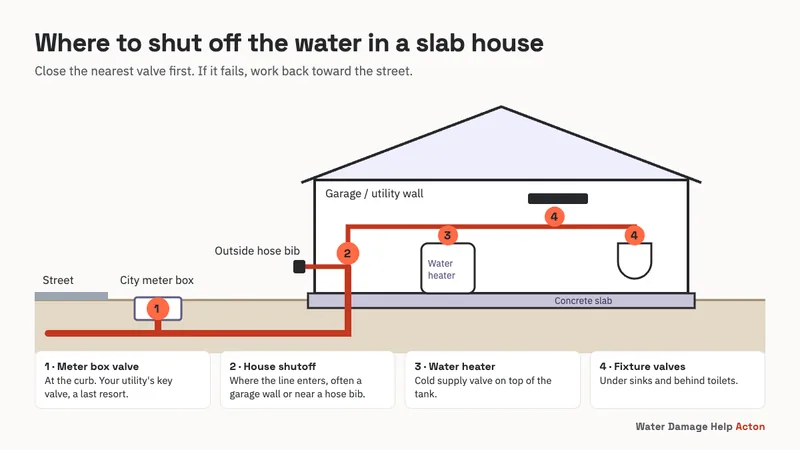
Category and class move independently. A small amount of sewage is still Category 3, and a large clean spill is still Category 1. Closing the shutoff early is the single cheapest decision, so find the valve before you need it. The figure below shows the usual spots to look.
What does each building material add to the bill?
Fixr's national figures show drywall as the cheapest material to restore and plaster as the dearest, with carpet, hardwood and mold work between them. Materials that soaked up water often cannot be dried in place, so replacing them becomes a separate line from drying.
| Surface or problem | Fixr, dollars per sq ft to restore |
|---|---|
| Plaster walls | $6.25 to $18.75 |
| Hardwood floors | $10 to $15 |
| Carpet | $4.75 to $10.50 |
| Mold treatment | $4.75 to $5.50 |
| Drywall | $1.50 to $3 |
Fixr, nationwide, 2025 edition.
Bob Vila prices some jobs by the room instead: $350 to $1,250 for ceiling repair, and $200 to $500 to restore floors. It also gives $1.50 to $3 per square foot for drywall, which matches Fixr. The two are separate surveys, so their other lines will not line up. Older houses with plaster walls are covered on the plaster walls page.
Do cold desert nights and winter storms change what I might pay?
They change the likely cause, not the price list. Nearby Palmdale averages about 52 mornings a year at or below freezing, according to Wikipedia's climate summary, and the freezing season runs from late November to late January. A split pipe from ice is Category 1 water, so it prices like any clean-water loss.
Palmdale also gets only about 5.9 inches of rain in a normal year. Because storms are rare, a sudden downpour can find the weak spot in a roof all at once. A ceiling stain after a storm is billed as ceiling repair, plus whatever the roofer charges to fix the leak.
- Frozen pipe. The plumber's repair and the drying work are separate bills. See how to thaw frozen pipes and burst pipe water damage.
- Storm leak. Roof repair, ceiling repair and drying each have their own price. See roof leak and storm water damage.
- Runoff from outside. Outside surface water is Category 3, so it sits at the top of the extraction table above.
How much does mold add after the water is gone?
Mold work is the cost you can often avoid. Bob Vila prices mold removal between $1,100 and $3,400, averaging $2,200, while Fixr quotes $4.75 to $5.50 per square foot. The EPA's advice for stopping mold before it starts is to get everything that got wet dry in 24 to 48 hours.
Drying quickly is cheap compared with removal. If a patch has already formed, the mold after water damage guide explains what a homeowner can handle and what needs a professional.
Why are drying and rebuilding billed separately?
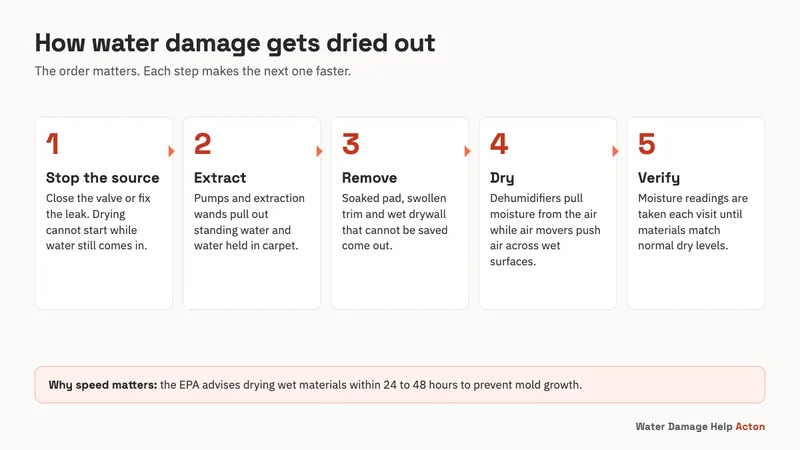
They are different jobs, and often different companies. Mitigation stops the damage from spreading: water out, ruined material removed, structure dried. Rebuild puts the house back with new drywall, paint, flooring and trim. Mitigation ends when readings show dry materials, and rebuild usually starts afterward.
Ask every provider whether a quote covers one phase or both. If a drying quote carries no rebuild line, you are looking at half a price, not a bargain. The water mitigation page covers the first phase and the water damage repair page covers the second.
What should a California contractor agreement say about money?
The Contractors State License Board (CSLB) sets a few payment rules for home improvement work in California. A deposit may not top $1,000 or 10 percent of the job price, whichever figure is lower, even for special-order materials. Later payments should track the work finished, not run ahead of it.
- License threshold. Since 2025, small jobs up to $1,000 can be done without a license if no workers are hired and no permit is needed, per a CSLB press release. The $1,000 counts labor and materials together.
- Cancellation. CSLB's consumer guide gives three business days to cancel, five if the buyer is 65 or older. Emergency repairs you request on short notice are an exception once the contract is signed and work begins.
- Changes. Any change to the work needs a written change order.
Acton is unincorporated, so a repair that needs a building permit goes through Los Angeles County. The repair permits page explains what to ask. CSLB's number is 800-321-2752.
Who pays: my insurer or me?
It depends on the cause and the policy. California's insurance department explains that homeowners policies exclude flood yet pay for other water damage. About 88.0 percent of occupied homes in Acton are owner-occupied, so most households will be weighing a repair bill against a deductible.
- Often covered: a sudden plumbing, air conditioning or appliance leak, and freezing of those systems, according to Triple-I.
- Not covered by standard policies: flood, per FEMA. Sewer backup usually needs an add-on, and mold or lack of maintenance is often excluded.
For scale, the Triple-I fact sheet puts the average water damage and freezing claim at $15,400 over 2019 to 2023. Your own loss and policy decide. The insurance claims guide covers filing.
How do I read a water damage estimate?
Check four things line by line: equipment days, square footage, materials removed and the records behind them. A clear estimate shows what each charge pays for. Triple-I suggests collecting written bids with each material and price on its own line, which lets you compare companies on the same rooms.
A fixed total quoted by phone without seeing the damage deserves caution, because the work depends on what the provider finds. Whether an estimate is free varies, so ask first. The glossary defines the terms on a bid.
What can I do to keep the total down?
Most of the savings come from the first day of a loss, before anyone has quoted a price. Stopping the water, clearing the wet zone and drying fast keep a job in a lower class. Work through these steps in order while you wait for bids and for the adjuster.
- Stop the source. Close the main shutoff or the nearest fixture valve.
- Move contents out of the wet area when it is safe, so furniture and boxes stop absorbing water.
- Photograph before cleanup, keep receipts, and keep damaged items until the adjuster has looked at them.
- Get itemized bids that separate drying from rebuild and show equipment days.
- Dry fast. The EPA wants indoor humidity under 60 percent, with 30 to 50 percent the better target.
The guide to choosing a restoration company lists more questions to ask. The contact page shows how to send a request. Restoration teams differ, so confirm details directly.
Sources: Fixr cost guide; Bob Vila cost article; IICRC S500 standard; EPA brief guide to mold; EPA mold cleanup page; CSLB release on the $1,000 limit; CSLB home improvement contract guide; California Department of Insurance claims guide; Triple-I on covered disasters; Triple-I insurance facts; FEMA flood insurance FAQ; Wikipedia on Acton; Wikipedia on Palmdale.