The short version
Old house water damage often starts at aging fittings and shows up as stains on plaster. Plaster costs more to restore than drywall, and paint in a house built before 1978 may contain lead. Stop the water, photograph it, dry in 24 to 48 hours as the EPA advises, and ask your insurer about depreciation and code upgrades.
Why does an older house get water damage differently?
Older materials have had more years to wear, and older homes were built to rules that have since changed. Seals dry out, fittings loosen and finishes such as plaster behave differently from modern board. Old house water damage is also harder to price, because the age of the house changes what a repair must meet.
Acton's own history is long. Wikipedia says the area began as a railroad camp from 1873 to 1876 and turned into ranching and farming country from the late 1880s. That tells you nothing about any one house, so find out when yours was built and what has been replaced since.
Wikipedia's 2020 census figures list 2,821 housing units in Acton, with 88.0 percent of occupied homes owner-occupied. For an owner, the age of the plumbing and walls is your responsibility, which makes a short inspection worthwhile before anything leaks.
Where should I look for weak spots in an older home's plumbing?
Start at the places water enters and leaves the house, then check every fixture connection. Most leaks begin at joints and flexible connectors, not in the middle of a pipe. A flashlight and a dry paper towel will find most slow drips in a few minutes.
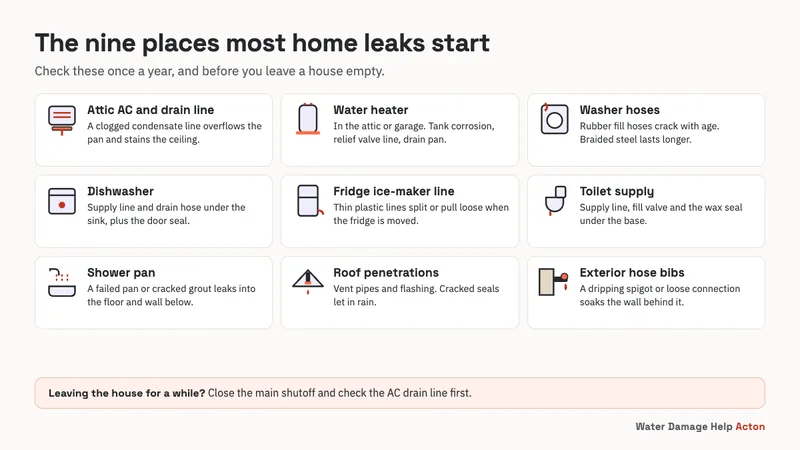
- Main shutoff and meter box: look for corrosion, drips or a valve that will not turn.
- Under sinks: check supply lines, shutoff stops and the drain trap for stains and white crust.
- Water heater: look at the connections, the base of the tank and the pan.
- Washer, dishwasher and refrigerator lines: look for bulges, cracks and damp floor.
- Ceilings below bathrooms: a new stain can mean a failing supply, drain or shower pan above.
If you do not know where your shutoff is, learn it now. If the house has polybutylene piping, read our polybutylene pipes guide, and for an upstairs stain see the ceiling water damage repair page.
What makes plaster walls different from drywall after a leak?
Plaster is heavier and harder to patch than drywall, and it costs more to restore. Fixr's national figures put plaster restoration at $6.25 to $18.75 per square foot against $1.50 to $3 for drywall. Water can make plaster stain, bubble, crumble or let go of its backing.
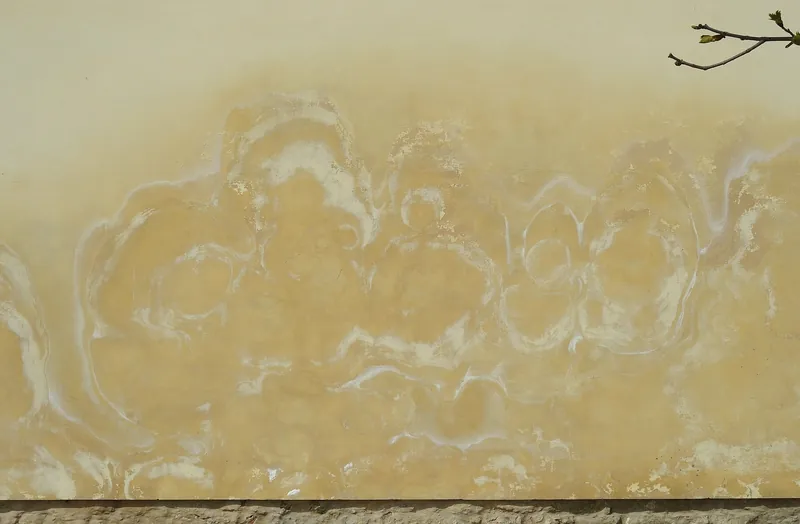

Because plaster is thick, a surface that looks dry can hold moisture behind it. A provider with a moisture meter can read the wall and tell you whether it can dry in place. Do not repaint until readings are normal, since paint over damp plaster peels and hides the problem.
Our plaster walls guide covers repair choices, and the drywall repair page explains how board differs. The water damaged floor repair page covers older wood floors.
Do I need to worry about lead paint when I open a wet wall?
If the house was built before 1978, yes, ask before anything is scraped or cut. The EPA says about three-quarters of homes in the United States built before 1978 still contain some lead-based paint, and that a repair that disturbs painted surfaces can create dangerous lead dust. Wet, peeling paint is a warning sign.
The EPA explains that paid work that disturbs paint in a pre-1978 home falls under its Renovation, Repair and Painting rule, which requires lead-safe work practices. In general the rule does not cover homeowners working in their own homes, but it does apply to rentals. California is not one of the states that runs its own version, so the EPA administers it here.
The EPA recommends that owners hiring out this work use a contractor trained in lead-safe practices. If you plan to do it yourself, use lead-safe methods, and keep children away from dust. You can reach the National Lead Information Center at 1-800-424-5323 for guidance. When you call a provider, ask whether they follow lead-safe practices on older paint.
What should I do first after a leak in an older house?
Stop the water, photograph the damage and start drying before you tear anything out. Older materials can be fragile, and a careless demolition can spread dust and spoil what could have been saved. Dust matters most where old paint is involved. Work in the order below, and pause at the paint step if the house predates 1978.
- Shut off the water. Close the house shutoff and open a faucet to drain the line.
- Turn off power where it is wet. Do not touch electrical equipment while standing in water, as Ready.gov advises.
- Photograph everything. Take pictures of walls, ceilings, floors and the failed part.
- Keep the old part. The corroded fitting or cracked line helps the plumber and the adjuster show what failed.
- Dry fast. The EPA's goal is dry in 24 to 48 hours, so use fans and a dehumidifier.
- Hold off on scraping or sanding paint. In a pre-1978 house, ask about lead first.
- Call your insurer. Report it right away and ask what it needs from you.
The restoration cost guide and the emergency water damage restoration page go deeper on what to expect.
How much does it cost to restore older building materials?
Costs vary by material, and older finishes tend to sit at the high end. Fixr's 2025 national restoration figures give per-square-foot ranges for common materials. Your quote will differ, so use these only to judge whether a number is in a sensible range.
| Material | Restoration per square foot | Found in older homes? |
|---|---|---|
| Drywall | $1.50 to $3 | Common in any age of house |
| Plaster | $6.25 to $18.75 | Typical of older construction |
| Hardwood | $10 to $15 | Often original floors |
| Carpeting | $4.75 to $10.50 | Added over time |
Across all jobs, Fixr lists $1,200 to $5,000 nationally, averaging $3,000. Bob Vila's range is $1,305 to $5,707 with a $3,455 average, attributed to Angi and HomeAdvisor. Get written bids that list materials and prices line by line.
Does insurance pay differently for an older home?
It can, because of depreciation and code upgrades. The California Department of Insurance says replacement cost pays to replace an item with one of similar kind and quality without deducting for depreciation, while actual cash value pays current market value and accounts for age and wear. Check which one your policy uses.
The department also says building codes change over time, so rebuilding a damaged section may require upgrades that a basic policy does not pay for. That cover appears as an ordinance or law endorsement, for a small additional premium. Triple-I adds that upkeep failures are excluded.
The upkeep point matters for older plumbing, because an adjuster may call a corroded line worn out. A sudden break is treated differently from a slow seep, so date the damage with photos and a plumber's note. The insurance claims guide explains how to document a loss.
Who can repair an older house, and does the work need a permit?
A plumber, a general contractor or a specialist does the repair, and a restoration team dries the structure. Acton is unincorporated, so permits come from Los Angeles County Public Works, Building and Safety, not a city. Ask the county what applies before opening walls, particularly for plumbing or structural changes.
The Contractors State License Board says a license is needed for work above $1,000 in labor and materials, or any amount if workers are hired or permits are required. Penalties for unlicensed contracting include administrative fines of up to $15,000. Check any contractor on the CSLB site before you sign.
See our repair permits guide for the county side. If you are shopping for a home, the buying a water damaged house guide explains what to inspect.
When should I call a restoration team?
Call when materials are wet, the stain is spreading or you smell mold. In an older home, early drying often decides whether plaster and original floors can be saved or must be replaced. Ask for moisture readings and photos at each stage.
Restoration teams set their own services and availability. Confirm directly whether a company works on plaster, handles older paint safely and documents moisture readings. The guide index lists every Acton topic.
Sources: Acton on Wikipedia; Fixr restoration costs; Bob Vila restoration costs; EPA lead renovation, repair and painting program; EPA mold and moisture guide; Ready.gov floods page; California Department of Insurance claims guide; Triple-I on covered perils; Triple-I on settling claims; CSLB handyperson release.