The short version
To prevent water damage in Acton, CA, learn and test your shutoff, insulate pipes before freezing nights, keep the AC drain clear, inspect the water heater and hoses, and check the house each season.
How can I prevent water damage in an Acton home?
Prevention comes down to four habits: know where your water shuts off, protect pipes before a cold night, keep drain lines and appliance hoses in good shape, and check the house on a schedule. Most losses start as small leaks that nobody noticed for a long time.
Per the Insurance Information Institute, roughly one insured home in 60 files a claim for water damage or freezing in a given year. Triple-I also notes that standard policies do not cover damage from lack of maintenance, so upkeep protects your claim as well as your floors. The signs of water damage guide covers spotting trouble early.
Where is my main water shutoff, and does it work?
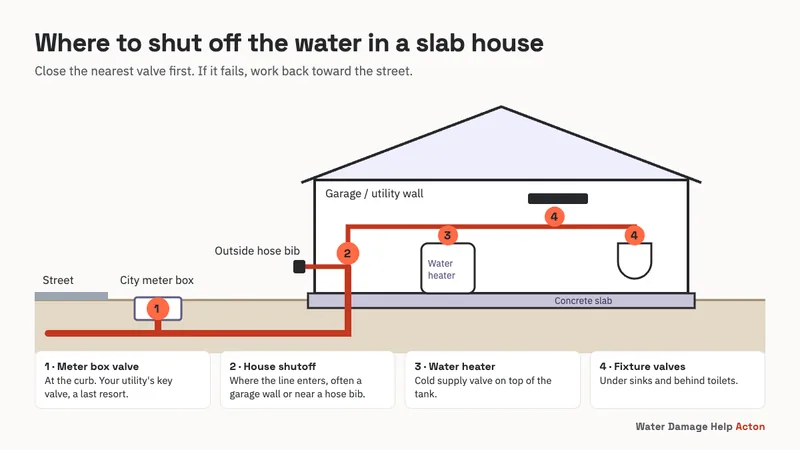
Find it before you need it and turn it once to confirm it moves. A valve that has not been touched in years can stick or leak when first used. Knowing the location lets anyone in the house stop a burst pipe in seconds instead of searching while water spreads.
- Locate the house shutoff, often where the line enters near an outside wall, in a garage, or in a utility closet. A meter box at the curb or property line may hold a second valve.
- Label it with a tag and show everyone who lives or stays there.
- Turn it closed slowly, then open a faucet to confirm the flow stops.
- Reopen it and watch the valve stem for drips. A weeping valve is a repair for a plumber.
- Find the stop valves under sinks and behind toilets, and turn each gently once a year.
If your property is on a well, ask the well or pump installer where the pressure tank and its shutoff are. The burst pipe page explains what to do next.
How do I protect pipes before a cold night?
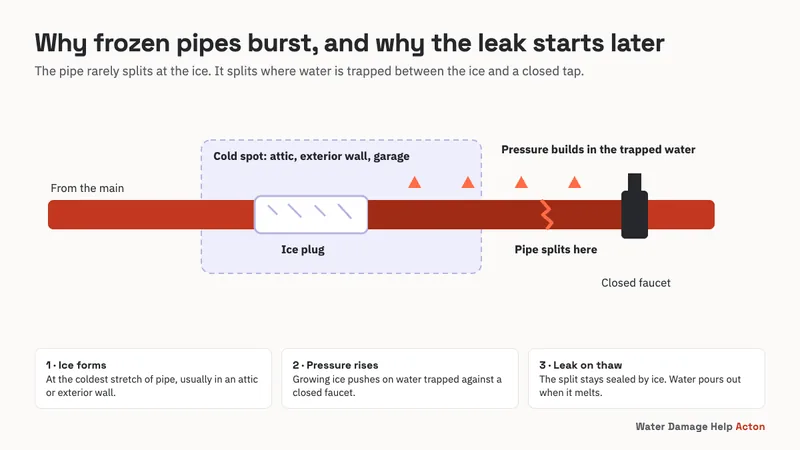
Insulate exposed supply pipes, keep the heat on, and let a faucet drip when a hard freeze is forecast. Wikipedia's summary of nearby Palmdale gives about 52 mornings a year at or below freezing, with normal minimums at or under freezing from late November to late January, so this is a real winter chore here.
The American Red Cross says pipes most at risk are supply pipes in unheated spaces such as attics, garages, crawl spaces and kitchen cabinets. It suggests letting cold water drip from faucets served by exposed pipes, and opening cabinet doors so warm air reaches the pipes.
- Wrap exposed pipes in garage, attic and exterior walls with foam sleeves.
- Disconnect garden hoses and shut off outdoor spigots that have their own indoor valve.
- Keep the thermostat at one setting day and night during a freeze.
If a pipe does freeze, the thawing frozen pipes page covers safe methods. Never use an open flame.
What should I do if the house will sit empty?
Tell your insurer, keep the heat on, and either shut off the water or arrange checks. Triple-I says many homeowners policies include a vacancy clause that limits or excludes coverage when a property is unoccupied, typically for 30 to 60 consecutive days. Read yours before you leave.
Triple-I advises keeping the thermostat at 55 F or higher in winter and considering remote leak monitors. The Red Cross gives the same 55 F floor for homes left in cold weather. That matters for cabins and weekend homes around Acton, where a leak can run for weeks unseen.
How do I keep the air conditioner drain from overflowing?
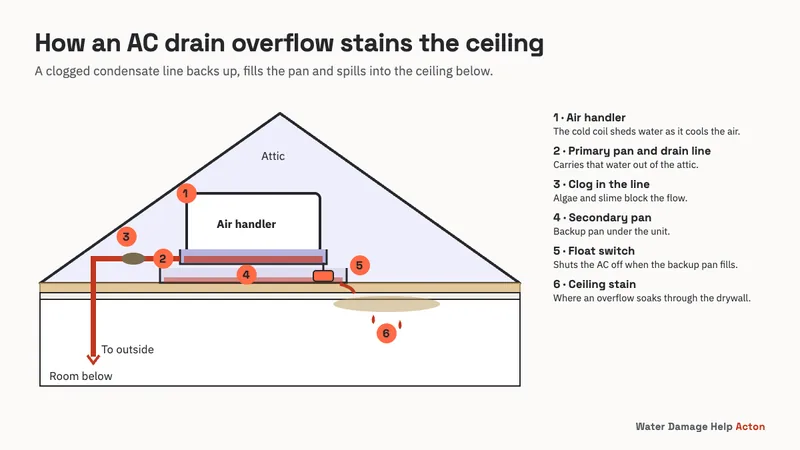
Have the condensate drain inspected before cooling season and replace filters regularly. ENERGY STAR says a plugged drain can cause water damage in the house, and that a yearly contractor check-up, ideally before the season, includes inspecting the condensate drain. Filters should be checked or changed monthly.
Watch for water around the indoor unit, a pan that holds standing water, or a ceiling stain below. A float switch, on units that have one, cuts power when the pan fills, so ask your HVAC technician whether yours does. The air conditioner leak page explains the overflow.
Which water heater, hose and appliance parts should I check?
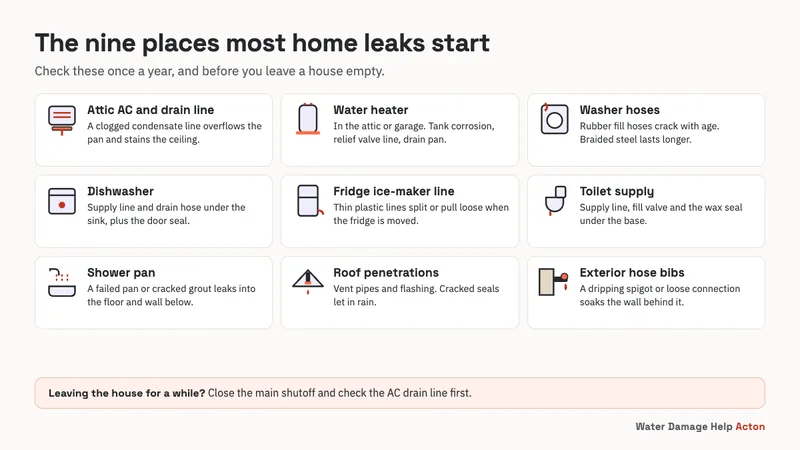
Look at the water heater, washer hoses, dishwasher and refrigerator lines, toilet supplies and under-sink connections twice a year. Rust, crust, drips, bulging hoses and a damp cabinet floor are the usual warnings. Replace hoses that look worn instead of waiting for them to fail.
California law also requires water heaters to be braced, anchored or strapped against earthquake motion, under Health and Safety Code section 19211, as hosted by the state Seismic Safety Commission. A strapped tank is less likely to tear its connections in a shake. See the water heater leak page and the appliance leak page.
Does high water pressure cause leaks?
It can. According to the Department of Energy's Building America Solution Center, plumbing codes mostly call for a pressure reducing valve once supply pressure tops 80 psi, since higher readings can burst pipes and harm fixtures. Keeping pressure at or below 60 psi reduces leaking faucets, heaters, pipes and hoses.
The City of Tustin notes that owners are responsible for their own pressure reducing valve when static pressure passes 80 psi, and that most professionals suggest a setting between 35 and 60 psi. A plumber can test pressure with a gauge on a hose bib. Well systems have their own pressure settings, so ask the installer.
Are leak sensors and automatic shutoff valves worth it?
For a house that is often empty, they can be. EPA's WaterSense program says leak detection and flow monitoring devices can identify leaks or alert you to irregular water use, which reduces damage. A sensor under a sink or beside a tank costs little compared with a flooded floor.
- Battery sensors sound an alarm where they sit.
- Connected sensors send a phone alert, useful when you are away.
- Automatic shutoff valves close the supply when flow looks abnormal, and need a plumber to install.
Providers and plumbers differ on products and installation, so ask what each recommends for your plumbing.
How do I prepare for winter storm runoff?
Keep water moving away from the house and know your coverage. Palmdale's normal annual rainfall is 5.90 inches over about 27 days, according to Wikipedia, so rain is rare but can arrive hard. Acton also sits where the Santa Clara River's upper branches join into a broad wash.
- Clear gutters, downspouts and any yard drains before the wet season.
- Keep soil and mulch from piling against exterior walls.
- Have a roofer check flashing, vents and chimneys for gaps.
- Store valuables off floors in rooms that have taken water before.
State insurance regulators explain that homeowners policies leave out flood but cover other water damage, and that flood cover is bought separately. A February 2025 department release adds that mudslide and debris flow are typically excluded, unless a recent wildfire or another covered peril is the cause. See the flooding after wildfire page and the roof leak page.
What should I check each season?
A short seasonal routine catches most problems. Put the dates on a calendar and take photos of each check so you can compare later. Photos also help if a claim ever arises, since they show the condition of the home before a loss.
| Season | Check | Why |
|---|---|---|
| Spring | AC drain line and pan, roof and gutters, outdoor spigots | Prepare the cooling system and clear winter debris |
| Summer | Filters monthly, hoses, stop valves, irrigation lines | Heavy cooling use and outdoor watering stress the system |
| Fall | Pipe insulation, gutters, drains, heater strapping | Get ready for freezing mornings and storms |
| Winter | Thermostat, dripping faucets in a freeze, ceilings after storms | Frozen pipes and roof leaks show up now |
EPA guidance puts the target for indoor humidity under 60 percent, with 30 to 50 percent best. Check it with a small humidity meter, and watch for condensation on windows or pipes.
What do I do if a leak happens anyway?
Stop the water, protect your belongings and call for help in that order. Fast action limits how much material soaks through. EPA advice is to dry wet areas and belongings in 24 to 48 hours so mold does not start, which makes speed important even for a small leak.
- Close the shutoff you located and tested.
- Take photos and video of the scene before you shift anything.
- Phone your insurer and ask what it needs before repairs begin.
- Move belongings out of the wet area.
- Call a plumber for the source and call a local restoration team for drying.
Reach out through the contact page, and see the insurance claims page for deadlines.
Sources: Triple-I, homeowners and renters statistics; Triple-I, coverage article; Triple-I, vacancy insurance; American Red Cross, Frozen Pipes; ENERGY STAR, Maintenance Checklist; Seismic Safety Commission, HSC 19211; DOE Building America, Service Water Pressure; City of Tustin, High Water Pressure; EPA WaterSense, Fix a Leak Week; EPA, mold and moisture guide; CDI, property claims guide; CDI, February 4, 2025 release; Wikipedia, Palmdale; Wikipedia, Santa Clara River