The short version
A mortgage company insurance check names your lender because the house secures the loan. The lender must endorse it and often holds the money in escrow, releasing it as repairs finish. Call the servicer early, ask for its process in writing and keep receipts, photos and invoices.
Why is my mortgage company on the insurance check?
Your lender has a financial stake in the house, so it is usually named on the claim check for structure repairs. The California Department of Insurance says that if your home is mortgaged, the check for home repairs will generally be made out to you and the mortgage lender. That is the standard setup, not a mistake.
This site does not handle claims. This page explains why the lender's name shows up, how that slows the money down, and what to ask so the repair work is not stuck. The idea is simple. The house secures the loan. If water damage lowers its value, the lender wants proof the money goes back into the house.
In Acton, 88.0% of occupied homes are owner-occupied, per 2020 census figures reported on Wikipedia. Not every owner has a mortgage, but many do, so this question comes up often after a leak or a storm.
What rights does the mortgage lender have to the claim money?
The lender gets equal rights to the check. The CDI claims guide says lenders usually require that they be named in the homeowners policy, and that the mortgage company or bank will have to endorse the check. Without the lender's signature, the check usually cannot be cashed.
The same CDI guide says lenders generally put the money in an escrow account. Escrow here means the lender holds the funds and releases them in steps as repairs are completed. Your loan documents describe the lender's exact rules, so read the mortgage and ask the servicer to explain its process in writing.
Lender rules cover structure payments most of all. Money for personal belongings is a different part of the policy and is often paid to you alone, but your insurer can confirm how your own claim will be issued. See the insurance claims guide for the full claim sequence.
How does the payment move from insurer to repairs?
The insurer pays, the lender endorses, the money sits in escrow if the lender requires it, and funds are released as work is verified. Each hand-off adds time. Knowing the order lets you start the lender paperwork on the first day instead of the last.
| Step | Who acts | What you can do |
|---|---|---|
| Report the loss | You and the insurer | Call right away, then ask how the check will be made out |
| Insurer decides | Insurer | Know the California deadlines listed below |
| Check issued | Insurer | Confirm both names and the mailing address |
| Lender endorses | Mortgage servicer | Ask for its loss draft or claim department |
| Funds held or released | Servicer | Ask what documents it needs for each release |
| Work is done and checked | Contractors, then servicer | Keep invoices, photos and signed completion papers |
Servicers name these departments differently, so call the number on your mortgage statement and ask who handles insurance proceeds for property damage.
How long does an insurer have to pay in California?
California rules set deadlines. The state's fair claims rules give the insurer 15 calendar days to acknowledge your claim (10 CCR 2695.5(e)). Once it has your proof of loss, it has 40 calendar days to say yes or no (2695.7(b)). If it says yes, payment follows in 30 calendar days (2695.7(h)).
Those are insurer deadlines, and they do not include the lender's time. An insurer that needs longer has to tell you so in writing before day 40 and repeat that notice every 30 days. A written denial must list its reasons and tell you that you can have the matter reviewed by the California Department of Insurance. The department's consumer hotline is 1-800-927-4357. Keep a log of every call with the date, name and what was said, because delays are easier to raise when you can show them.
What if repairs cannot wait for the lender's money?
Emergency steps usually cannot wait. Stopping more harm is your job even while the claim is open. Triple-I points owners to temporary protection and receipts, with big permanent fixes waiting for the adjuster. Drying and water removal fit that advice, and your insurer can tell you which costs it will reimburse.

Ask your insurer whether emergency work can be paid separately from the structure check. Ask the restoration team what it requires up front, since restoration teams differ. The water mitigation page explains what early work covers, and the water removal page covers pulling water out. Do not sign anything that says the provider will be paid directly from your claim without reading it. Your lender and insurer may have their own rules about that.
How do I pay a contractor when the lender holds the money?
Match payments to completed work. California's contractor board (CSLB) caps a home improvement down payment at $1,000 or 10 percent of the price, whichever is smaller, and tells owners to pay only for finished work. Staged lender releases fit that pattern.
Before the work starts, ask the contractor to put a payment schedule in the contract that lines up with the lender's release steps. Collect bids that itemize materials and prices, which is also what Triple-I recommends. Keep every invoice, photo and receipt, since the servicer may ask for proof before each release. The guide to choosing a restoration company lists questions worth asking, and the water damage repair page explains the rebuild phase.
What should I do first when the lender's name is on the check?
Call the servicer before the check arrives. Ask for its insurance proceeds process, its forms and its timeline in writing. That one call can save weeks, because many delays come from missing paperwork rather than from anyone refusing to pay.
- Report the loss to your insurer immediately, as the CDI advises, and ask how the check will be issued.
- Call your mortgage servicer and ask for the loss draft or insurance claims department.
- Request the process in writing, including forms, inspections and release steps.
- Protect the house. Stop the leak, dry the area and keep receipts.
- Photograph everything before and after work.
- Get written bids and share them with the insurer and servicer.
- Keep a call log with dates, names and what each person said.
What if the lender is slow or the check is wrong?
Start with the servicer's claims department and ask for a named contact. If the insurer is the holdup, the CDI says to contact it if you are having difficulty with your claim. Complaints can be filed online or by calling 1-800-927-4357, and the insurer must respond to the department within 21 calendar days.
A check made out to the wrong name, or without the lender when the lender should be listed, usually has to be reissued, so do not alter or deposit it before asking. Talk to your agent first. Your mortgage servicer is a separate company, so complaints about it go through its own channels and are not handled by the insurance department. If a delay puts work on hold, ask providers whether they will stage the job, since some do and some do not.
When should I call a restoration team?
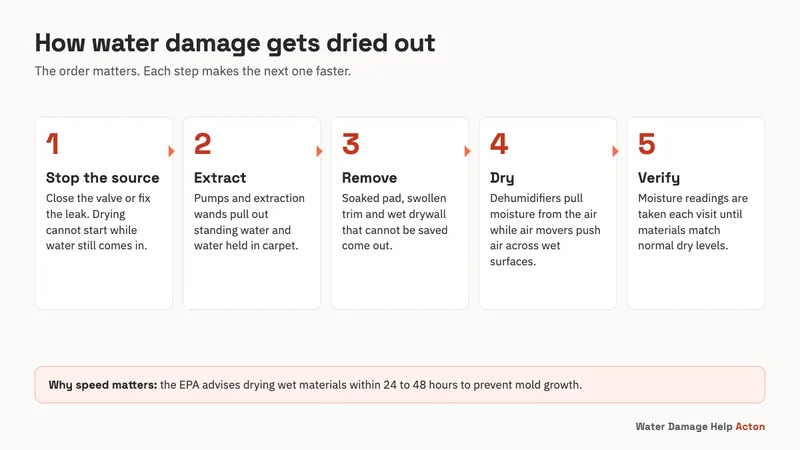
Call as soon as water is in the house, before the claim money question is settled. Early drying limits damage and cost. The EPA says wet areas and belongings should be dry in 24 to 48 hours to keep mold from starting, which is faster than most lender processes.
Restoration teams differ in how they handle insurance paperwork, so confirm directly what documents they give you and whether they work with your insurer. Ask for photos, moisture readings and an itemized invoice you can send to both your insurer and your lender. More help is in the Acton water damage guides.
Sources: California Department of Insurance, Residential Property Claims Guide; CDI, complaint page; 10 CCR 2695.5; 10 CCR 2695.7; CSLB, Terms of Agreement; Triple-I, claim settlement guidance; EPA, Brief Guide to Mold, Moisture and Your Home; Wikipedia, Acton, California.