The short version
When choosing a restoration company in Acton, CA, get an itemized written estimate, read every form before signing, ask to see moisture readings and check each license on the state lookup. California sets a down payment limit on home improvement contracts. This site ranks no company.
How do I go about choosing a restoration company in Acton?
Compare at least two providers on paperwork, not promises. Choosing a restoration company in Acton, CA comes down to an itemized written estimate, a clear scope, the right California licenses for each trade and a contract you have read in full. Acton is small, so ask where a provider's crew would be coming from.
- Stop the source first. Close the valve or call a plumber, so the water stops while you compare.
- Call two providers and describe the same problem to each, so the answers line up.
- Ask for a written, itemized estimate before you approve anything beyond emergency protection.
- Check each license that applies, using the state lookup rather than a card or a truck door.
- Read the contract and every authorization form, and leave no blank lines.
According to Triple-I, a good bid is in writing, comes from a licensed contractor and itemizes materials and prices. Skip the third quote if standing water is still spreading.
Which restoration company is the right one for me?
No one can name that from a distance, and this site does not rank providers. The right choice is the one that answers your questions plainly, puts the scope and price in writing and holds the licenses your job needs. Availability and prices vary, so confirm them directly with each provider.
Treat online reviews as a single input. They say little about your particular job, and they cannot show you a contract. Give more weight to how the provider describes the work and whether the numbers match what you were told on the phone.
What should I ask before I hire anyone?
Ask questions that force a specific answer, and put the same ones to every provider. Someone who has done this work can describe the steps, the equipment and the paperwork without hesitating. Write down each reply as you hear it, then compare the notes side by side before you decide.
| Question | Why it matters | A solid answer |
|---|---|---|
| Will the estimate list each line item? | A single total hides what each part costs | Yes, with equipment, labor and materials shown separately |
| Which materials come out, and which stay? | Demolition sets the size of the rebuild | A room-by-room list with a reason for every removal |
| Which license numbers apply to this job? | Plumbing, general repair and other trades differ | Numbers you can look up yourself |
| How will you show the drying is finished? | Wet materials left behind grow mold | Dated moisture readings you can see |
| What happens if the scope grows? | Hidden damage often turns up after demolition | A written change order before extra work starts |
| Will you work with my insurer? | Claims need documentation and approvals | Yes, but the policy and the insurer decide what is paid |
The restoration cost guide explains what drives an estimate up or down.
What licenses should a provider hold in California?
It depends on the work. The Contractors State License Board (CSLB) licenses and regulates about 285,000 California contractors, and it offers an online check for any license or home improvement salesperson registration. Plumbing, drywall and rebuild work generally fall under contractor licensing.
Mold is different. The California Department of Public Health (CDPH) says the state has no licensing, training or certification requirement for mold assessors or remediators, and no state rules on inspection or remediation. Some providers hold national credentials from groups such as IICRC, which CDPH lists only for information and does not endorse.
The CSLB's 2025 handyperson rule lets an unlicensed person take only jobs up to $1,000, with no workers and no permit.
So a mold company without a state license is not breaking a licensing rule, but you can still ask what credentials and experience it has. For other trades, check the CSLB contractor page before work begins.
What am I signing when I approve the work?
Usually a work authorization, a contract or both. Read every line, because the paper sets the scope, the price and your rights. A short authorization to start protecting the property can be routine, but never sign a form with blanks that someone promises to fill in later.
- The scope of work, by room, with the work described in plain words.
- The price, or the method for pricing, with equipment and labor split out.
- Who handles insurance paperwork, and whether you assign any payment to the provider.
- The payment schedule and what triggers each payment.
- How change orders work, and a start and finish estimate in writing.
In its home improvement contract guide, the CSLB sets the down payment ceiling at $1,000 or 10 percent of the price, whichever amount is smaller. Its advice on later payments is to hand over money only as work gets done, and to require a written change order for any change.
Do I have time to cancel a contract?
Sometimes. Per the CSLB guide, the buyer of a home improvement job gets three business days to cancel, five when the buyer is 65 or older, and the contractor then returns any payment within 10 days. A contract negotiated at the contractor's own office carries no such right.
There is an exception that matters here. The same guide says the cancellation right is voided when you request emergency repairs on short notice under a service and repair contract, once the contract is signed and work begins. In a real emergency you may not get a cooling-off period, so read first.
How do I spot a storm chaser after a big weather event?
Be wary of anyone who knocks on your door first, pressures you to sign at once or asks for a large deposit. Heavy rain or runoff can bring out contractors from far away. A legitimate provider will still give you a written estimate and a license number you can verify.
Check any unfamiliar company before you pay. Look up the license, ask for a local address and get the scope in writing. Anyone who refuses to put terms on paper is telling you something.
If an insurer proposes a vendor, find out whether your policy actually requires it. You may be free to choose, though the insurer's reading of the policy governs.
What daily readings and records should I expect?
Expect moisture readings taken and recorded across the drying period. Moisture readings show whether materials are drying toward a normal level, and a provider who monitors them can tell you when equipment can come out. Ask to see the log, not just hear a verdict.
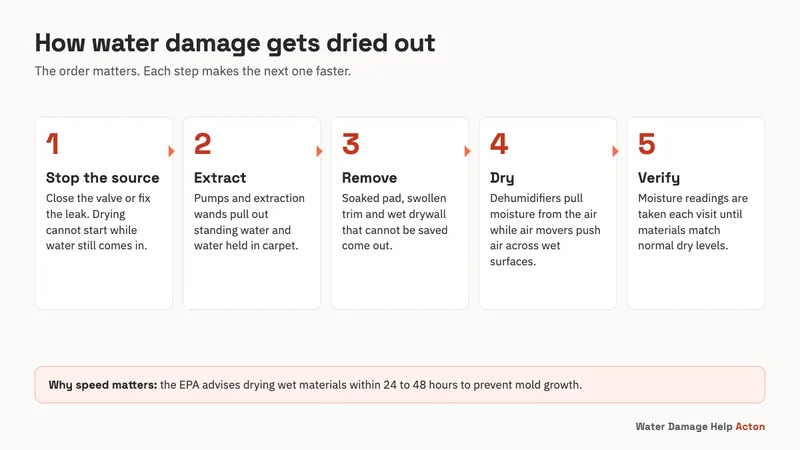
Because the EPA ties mold prevention to drying within 24 to 48 hours, a plan should start quickly. The structural drying page explains the equipment and the monitoring.
The IICRC S500 standard describes professional water damage restoration and assumes finding and fixing the source of the water is the owner's responsibility. A provider may take that on by agreement, but get it in writing.
What are the red flags with a restoration company?
A few warning signs show up again and again in complaints about restoration work. Any one of them is a reason to pause, ask more questions and compare another provider before you commit money or sign anything. Treat two or three together as a reason to walk away.
- No written estimate, or a single lump sum with no detail.
- A demand to sign immediately, or a form with blank lines.
- A deposit larger than the CSLB's limit for a home improvement contract.
- Pressure to commit to big permanent repairs before your insurer has inspected.
- No license number, or one that does not match the name when you check it.
- An offer to cover your deductible or inflate the claim.
Triple-I counsels waiting on large permanent repairs until the adjuster has made an assessment. If you consider a public adjuster, the same source puts their cost at up to 15 percent of a settlement, and says to vet them with the state insurance department.
What if I think an invoice is too high?
Ask for an itemized invoice and set it beside the signed estimate and any change orders. Keep your dates, photos and messages. Many disputes grow out of scope changes that nobody wrote down, so the paper trail is your strongest tool.
- Request a line-item invoice and the drying records.
- Compare it against the written estimate and change orders.
- Tell your insurer if a claim is involved, before you pay a disputed amount.
- Complain if needed to the CSLB at 800-321-2752 or through the CDI at 1-800-927-4357 for claim problems.
This site is part of Water Damage Cleanup California. No restoration team is ranked or endorsed here. Read the claims guide or the water mitigation page for what a first visit should cover.
Sources: CSLB guide to home improvement contracts; CSLB release on the handyperson limit; CDPH mold FAQ; Triple-I, settling claims; EPA mold and moisture guide; IICRC S500 page; CDI claims guide.