The short version
Sewer backup insurance coverage is usually a separate endorsement or product, because Triple-I says a typical homeowners policy and flood insurance both leave sewer backups out. Check your policy now, photograph any loss, report it right away and call a professional for contaminated water.
Does homeowners insurance cover a sewer backup in California?
Usually not on its own. Triple-I reports that a typical homeowners policy leaves sewer backups out, and a flood policy does too. That gap surprises many owners, because a backup looks like a plumbing problem. Sewer backup insurance coverage is normally bought as its own piece.
California's insurance regulator draws a line between flood, which homeowners policies exclude, and other water damage, which they often include, and it tells you to ask your insurer about any specific loss. A backup sits between those two ideas, which is why the policy wording matters more than the label on the loss.
Acton is an unincorporated community, and Wikipedia counts 2,821 housing units there, with 88.0 percent of occupied homes owner-occupied. For an owner, a backup bill lands on you unless the policy says otherwise. Read your declarations page before you need it.
What is a sewer backup endorsement and what does it add?
An endorsement is an add-on to a homeowners policy that covers water coming back up through drains. Per Triple-I, the cover is offered as an endorsement or a standalone product, and the price is usually small. Owners use it to close the gap the standard form leaves.
Wording varies between insurers, so ask direct questions before you rely on it:
- What is the coverage limit, and is it separate from the main policy limit?
- Is there a separate deductible for backups?
- Does it pay for cleanup and drying, or only for repairs and replacement?
- Does it cover contents such as stored boxes and furniture?
- If the property uses a septic system instead of a public sewer line, does the wording still apply?
Ask for the answers in writing. If your agent cannot find an endorsement, ask whether another insurer offers one. The California FAIR Plan is a bare-bones policy, and the state insurance department says owners on it must buy an additional policy for water damage and other common perils.
Which policy covers which kind of water?
Each water source maps to a different kind of cover, and sewage and flood are handled separately. Here is how the main sources line up, based on what Triple-I, NAIC, FEMA and the state insurance department publish. Your policy governs, so treat this as a map for questions, not an answer.
| Source of water | Standard homeowners policy | Where cover may come from |
|---|---|---|
| Sewer or drain backup | Typically not covered (Triple-I) | A sewer backup endorsement or separate product; flood and earthquake policies do not cover it |
| Rising flood water, ground water, rain runoff | Excluded (NAIC, FEMA) | A separate flood policy, which takes effect 30 days after purchase in most cases |
| Leaking plumbing or a roof leak | Typically covered (NAIC) | The homeowners policy, subject to its maintenance exclusion |
| Earthquake damage | Not covered | An earthquake policy, which does not cover sewer or drain backup either (CDI) |
The IICRC S500 standard puts sewage in Category 3, grossly contaminated water. Our flood cleanup page and the sewage backup cleanup page explain how that category changes the work.
How does a sewer backup reach a house, and why does it cost so much?
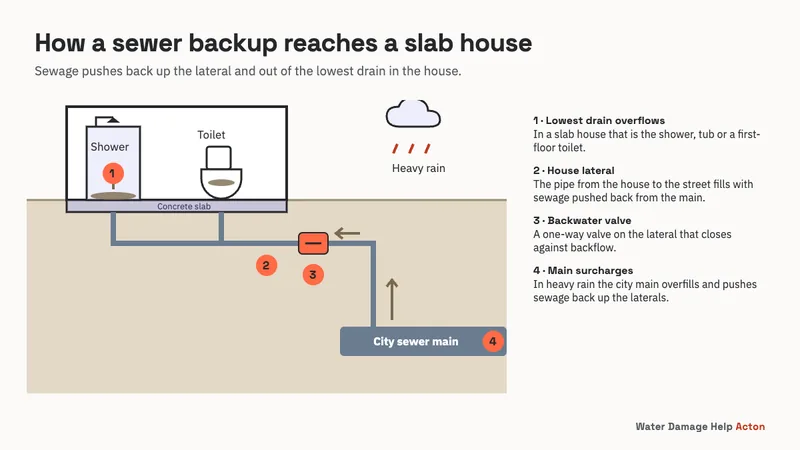
A blocked or overloaded sewer main pushes sewage up the lateral and out of the lowest drain in the house, such as a floor drain, tub or shower. Because the water is contaminated, it costs more to remove than clean water. That cost gap is the main reason to price an endorsement now.
Fixr's national price tables show the gap. Pulling out clean water is listed at $3.75 to $4.25 per square foot, gray water at $4.10 to $6.50 and black water at $7 to $7.50. Treat these as national ranges rather than Acton quotes, and note they cover extraction only.
When sewage caused the damage, the EPA wants a professional who has worked on contaminated buildings. Porous items that touched sewage are often discarded, so check whether your endorsement pays for contents.
What should I do in the first hours after a sewer backup?
Keep people and pets out of the wet area, stop using the drains and call your insurer. The state insurance department says to report water damage immediately to your agent or company. Take photos before anything is moved, because the adjuster needs to see the loss.
- Stay out and keep others out. Sewage can carry germs, so do not wade in it barefoot.
- Stop using water. Do not flush or run sinks, tubs and washers until the line is cleared.
- Photograph and video. Capture the water line, the drain and every damaged item.
- Call your insurer. Ask what your policy says about backups and what steps it wants before cleanup.
- Call a plumber. A plumber finds and clears the blockage. That is a different job from drying the house.
- Call a restoration team. Contaminated material has to come out and the area has to dry.
The CDC says to wear rubber boots, gloves and goggles when cleaning, and never to mix bleach with ammonia or other cleaners. The EPA's clock for drying is 24 to 48 hours. For the cleanup side, see sewage backup cleanup.
How do I file a sewer backup claim and what deadlines apply?
Tell the insurer right away and put the claim in writing. Under California's claim rules, the insurer has fifteen calendar days to acknowledge your claim, forty calendar days after proof of claim to accept or deny it, and thirty days to pay once it accepts. Those clocks are in the state regulations.
If it cannot decide in time, it must tell you in writing and update you every thirty calendar days. A denial has to be in writing, list its reasons and tell you that you can have the matter reviewed by the California Department of Insurance. Triple-I adds that you should save receipts and not throw out damaged items before the adjuster visits.
If you disagree, ask the claim manager to review it, ask about an independent appraisal, or file a complaint at 1-800-927-4357. The insurance claims guide goes through each step. For the cover that applies after a sudden flood event, see the flood cleanup page.
What if I have no sewer backup coverage?
You pay for cleanup and repairs yourself, so act quickly to limit what spreads. Contain the area, document everything and get written bids. Triple-I advises getting bids with materials and prices listed line by line, which also helps if you later dispute a denial.
Ask the plumber where the blockage was. If it was in your own lateral line, repair is normally your job. If it was in the public main, ask the sewer agency serving your address whether it has a claim process, since who maintains the main depends on where you are.
Then fix the gap for next time. Ask an agent about a sewer backup endorsement, and ask a plumber whether a backwater valve fits your line. Compare quotes, because wording and limits differ between insurers. The mortgage lender and insurance check explains how lenders see your policy.
When should I call a restoration team?
Call as soon as the plumber says it is safe to work. Sewage soaks flooring, baseboards and drywall quickly, and the first 24 to 48 hours matter. Ask your provider about moisture readings, what they remove and how they handle contaminated material.
Restoration teams set their own terms, services and availability. Confirm directly that a company handles Category 3 water before you agree to anything. The guide index lists the other Acton topics.
Sources: Triple-I on covered perils; Triple-I on settling claims; NAIC homeowners page; FEMA flood insurance FAQ; state insurance department claims guide; state insurance department earthquake page; state insurance department flood page; state release on the FAIR Plan; Fixr restoration costs; IICRC S500 standard; EPA mold cleanup page; CDC mold page; 10 CCR 2695.5 and 2695.7; Acton on Wikipedia.