The short version
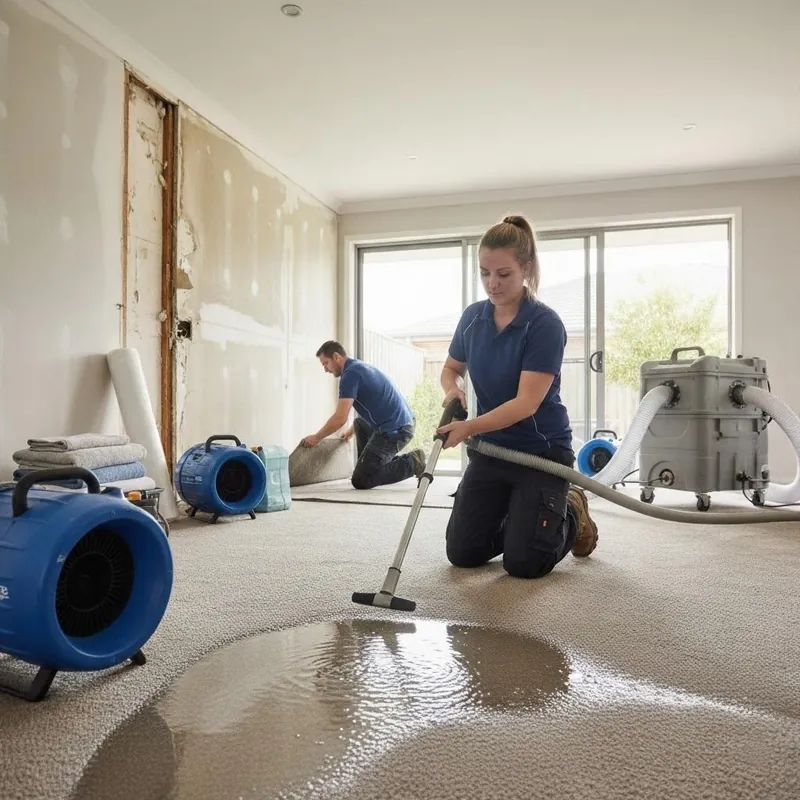
Water mitigation in Acton, CA limits how far a loss spreads. A provider checks the damage, extracts standing water, removes materials that will not dry, runs dehumidifiers and fans and logs moisture readings. The EPA suggests drying within 24 to 48 hours. Rebuilding is a later phase.
What is water mitigation for an Acton home?
Water mitigation is the first phase after a water loss: find and stop the source, remove standing water, pull out what cannot be saved and start drying. Its goal is to keep the damage from growing. In Acton that can follow a split pipe, a roof leak, a failed appliance hose or storm runoff.
You may also see water remediation, water damage mitigation or emergency mitigation on quotes. Companies use these labels loosely, so look at what the paperwork actually lists instead of trusting the title.
Speed is why this phase comes first. To head off mold, the EPA wants wet areas and belongings dry inside 24 to 48 hours. Owners in Acton and Palmdale can call to reach a local restoration team, and each team sets its own scope and terms.
How is mitigation different from restoration?
They are two stages. Mitigation holds the loss in check and dries the building, and restoration puts back what was removed or ruined. A single company can offer both. Even so, each stage carries separate paperwork, often a separate bill, and sometimes separate treatment by the insurer.
| Mitigation | Restoration | |
|---|---|---|
| Aim | Contain the damage, dry the structure | Rebuild what was removed or ruined |
| Begins | When the source is stopped and the space is safe | After readings show dry materials |
| Typical work | Extraction, tear-out, drying machines, readings | Insulation, drywall, flooring, trim, paint |
| Insurance angle | Temporary steps to prevent more loss | Follows the adjuster's review |
On the insurance row, the California Department of Insurance says reasonable protection costs are reimbursed with receipts and are part of the total settlement. The rest of the table describes how the phases usually go. Ask directly whether one company will cover both, and see water damage repair in Acton for the rebuild side.
What does a provider do on the first visit?
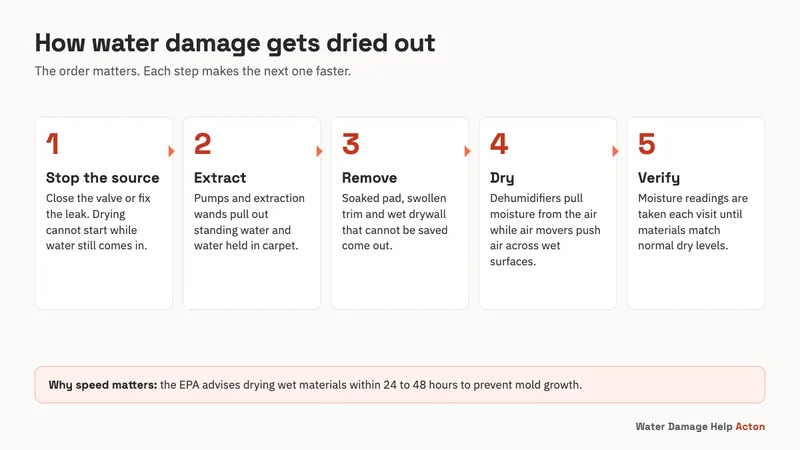
Typically the first visit brings an inspection, extraction, tear-out of what will not dry, and equipment placement. Careful providers also log starting conditions as a baseline. Order varies with the damage, yet the list below is a fair picture of what a home visit looks like.
- Make it safe. Someone, you or a plumber, closes the water valve. Then the crew scans for shock and slip hazards.
- Sort the water. IICRC S500 labels clean supply-line water Category 1, grey water (appliance discharge, toilet overflow without waste) Category 2, and grossly contaminated water such as sewage or rising flood water Category 3.
- Map the wet area. A meter, and sometimes a thermal camera, shows how far the water traveled into walls, floors and ceilings.
- Extract. Pumps and wand tools lift standing water off floors; water removal and extraction goes into detail.
- Remove the unsalvageable. Sodden padding, swollen trim and saturated wallboard are common first removals.
- Place equipment. Air movers blow across wet surfaces, and dehumidifiers collect what evaporates.
- Record readings. Every return trip adds numbers until each material is dry.
Dirty water alters the plan, since porous materials tend to be removed. Outdoor water is covered in flood cleanup in Acton, and sewage in sewage backup cleanup, where the advice is to keep out of it.
How does a moisture survey choose what gets removed?
The survey splits materials into dry-in-place and remove. Water wicks up wallboard and travels along framing, so wet zones often extend past the stain you can see. Meter readings at marked points show the true edge and can be retaken at each visit.

Cutting out material can seem extreme, yet it shortens drying and cuts the chance of mold you cannot see. Request photos before any removal and the numbers behind each decision. The structural drying page explains how the machines work afterward.
How long should mitigation last?
Drying should begin within the 24 to 48 hours the EPA cites for mold prevention. The finish date then turns on the water category, the materials and the spread. No verified Acton duration exists here, so ask for target readings and a review date.
Numbers on a meter, not days on a calendar, mark the finish. A good provider measures wet areas against a dry patch of the same material elsewhere in the house.
The EPA's indoor humidity advice is under 60 percent, best at 30 to 50. When machines keep running and nobody can name the target number, ask.
What should a drying log show?
A drying log lists readings, room conditions and equipment for every visit. It proves the work did its job and is the first record to produce if an insurer disputes the bill. Ask to see it whenever someone visits, and keep a copy.
- Meter readings from identical marked spots, dated.
- Indoor humidity and temperature, compared with the EPA range.
- Equipment in place: counts of air movers and dehumidifiers and their locations.
- Changes in equipment, with reasons.
- Photos taken before, during and after.
File it with your claim records.
Is a rented dehumidifier enough for a leak?
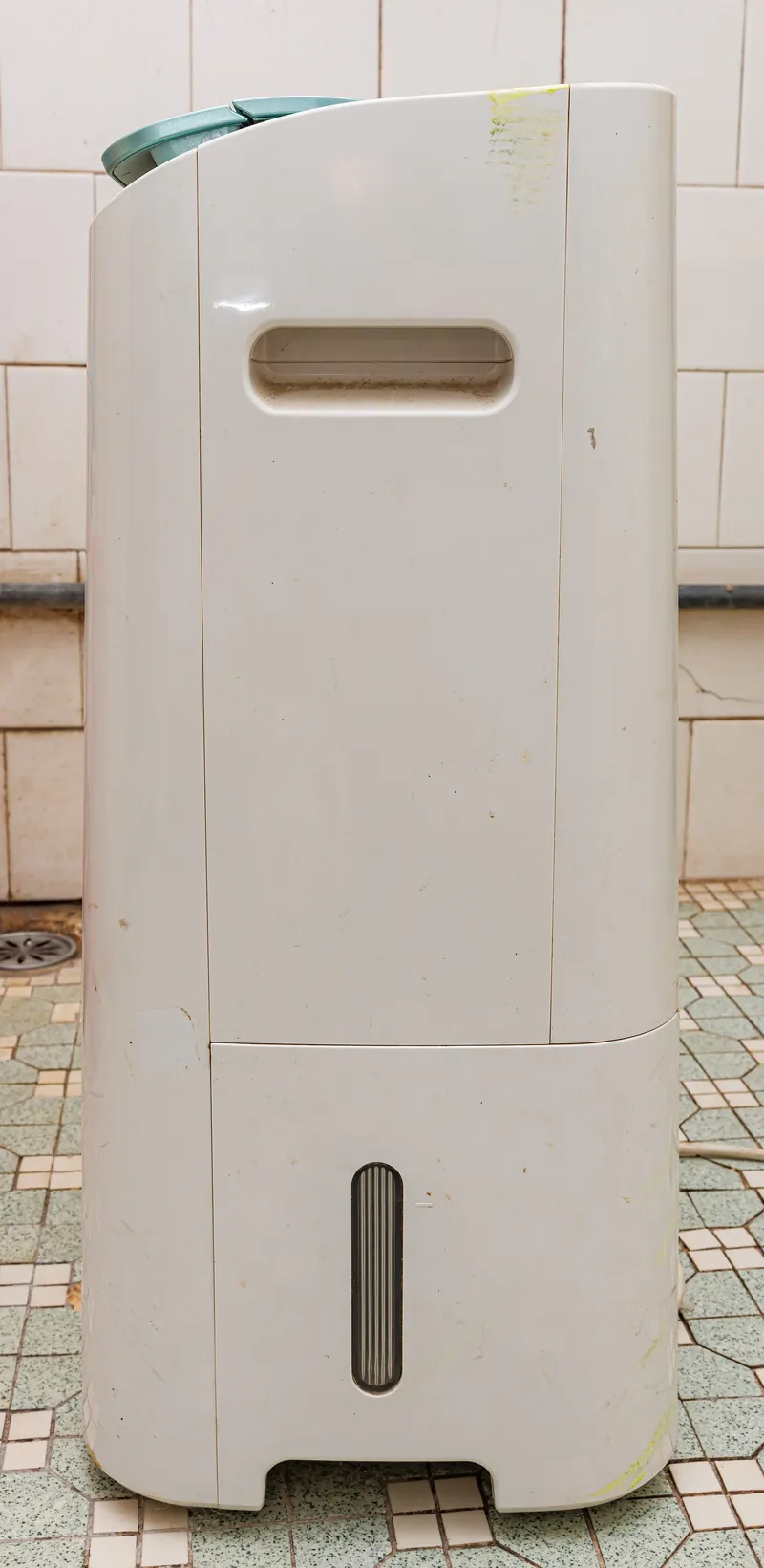
For a small clean spill, maybe. A rental can handle a damp patch on a hard floor. For anything wider, a rental unit alone rarely finishes the job because it cannot pull water out of wall cavities, insulation or the layer under flooring. Use the table to place your loss.
| Situation | Do it yourself | Professional drying |
|---|---|---|
| Small clean spill on tile | Mop up, add airflow, keep watching | Usually unnecessary |
| Drenched carpet and pad | Risky: padding retains water | Extraction and pad removal |
| Water inside walls or under floors | Cannot be gauged by eye | Meters and targeted drying |
| Grey or black water | Unsafe for you to handle | Needed |
The EPA's view is that contaminated water needs a professional. Going solo, still aim for the 24 to 48 hour mark and sniff for mustiness in the following weeks. The mold guide covers what to do if one shows up.
Do cold nights near Acton change the plan?
It can, because cold snaps are a common cause of burst pipes here. Wikipedia's normals for neighboring Palmdale record about 52 mornings a year at or below freezing, with minimums at or under freezing from late November to late January. Acton's own summers are warm and dry, with no monthly average above 71.6 F.
The American Red Cross says pipes in unheated spaces such as attics, garages, crawl spaces and kitchen cabinets are most at risk, and recommends keeping the heat at 55 F or higher when you are away. Which spaces in your house stay unheated is something to check for yourself, because no source describes Acton homes.
After a freeze break, the heat usually needs to stay on during drying. Ask the provider what thermostat setting they want. The burst pipe page covers the plumbing side.
What does water mitigation cost nationally?
Nationally, full jobs land in the low thousands of dollars. Fixr, in a page updated January 31, 2025, lists $1,200 to $5,000 for water damage restoration with $3,000 as the average. These are national numbers and not Acton quotes, so use them only for orientation.
| Fixr national figure | Range |
|---|---|
| Clean water extraction, per square foot | $3.75 to $4.25 |
| Gray water extraction, per square foot | $4.10 to $6.50 |
| Black water extraction, per square foot | $7 to $7.50 |
| Class 1 damage, flat | $150 to $400 |
| Class 2 damage, flat | $500 to $1,000 |
| Class 3 damage, flat | $1,000 to $3,000 |
Each figure above is Fixr's, from its restoration cost page. What a given provider charges is not something this site can state. Water damage restoration cost in Acton has more.
Does California insurance pay for mitigation?
Frequently, if the cause is covered. Plumbing and roof leaks are typically covered, according to the NAIC, and ground water and rain runoff typically are not. The state insurance department separates flood, which homeowners policies omit, from other water damage, which they handle.
In its claims guide CDI urges owners to stop leaks at their source, says drying and dehumidifying can reduce the chance of mold, and warns that waiting lets mold set in. It also advises caution with contractors who press for big temporary repairs.
- Tell your agent or insurer soon.
- Triple-I suggests postponing large permanent repairs until an adjuster has looked.
- Shoot photos or video, and hold damaged items for the adjuster.
- Keep receipts and request written, itemized bids.
California insurers have 15 calendar days to acknowledge a claim under 10 CCR 2695.5. The insurance claims guide walks through the sequence.
How do you read a mitigation invoice and work authorization?
Good invoices show each charge beside a quantity. Weak ones give one lump total, and disputes usually start there because nobody can compare the bill to the work. Request the items below before paying, and read an authorization form to the end before signing.
- Itemization. Extraction, tear-out, equipment and labor priced separately.
- Machine counts and days, consistent with the log.
- The log, which explains why machines stayed.
- Photographs of what was removed and which rooms were hit.
- Insurer contact: who bills it, and who pays any shortfall.
Warning signs: a price over the phone before anyone inspects, and machines humming with no readings behind them. CSLB's consumer guide limits a home improvement deposit to $1,000 or 10 percent of the price, whichever is less, and says to pay as work is finished. It adds that a contract for emergency repairs requested on short notice is an exception to the three-day right to cancel.
Never sign a blank or half-filled form. Such a form may assign insurance benefits or set lien terms, and this site is not a party to any provider's contract. Answers vary, so confirm each point directly, and see the guide to choosing a restoration company.
What comes after the drying is done?
Once the structure reads dry, the machines go and rebuilding can start with insulation, drywall, flooring, trim and paint, in whatever order the repair plan sets. Adjusters generally inspect before permanent work, so wait on rebuilding and keep the drying records safe.
Keep the log, photos and invoices together. If a musty smell shows up weeks on, the log makes it easier to see what was dried and how. Repairs may need a county permit, and Acton falls under Los Angeles County Public Works, Building and Safety. To ask for a connection, use the contact page.
Sources: EPA moisture guide; EPA mold cleanup page; IICRC S500 overview; CDI property claims guide; Regulation 2695.5; NAIC consumer page; Triple-I, claim settlement; Fixr cost page; Red Cross frozen pipes page; Wikipedia on Palmdale; Wikipedia on Acton; CSLB contract guide.