The short version
In an Acton emergency, shut the nearest valve, stay away from wet wiring and gas appliances, and photograph the scene. Next phone your insurer and a restoration team. Mold guidance from the EPA sets the drying goal at 24 to 48 hours.
When is water damage an emergency near Acton?
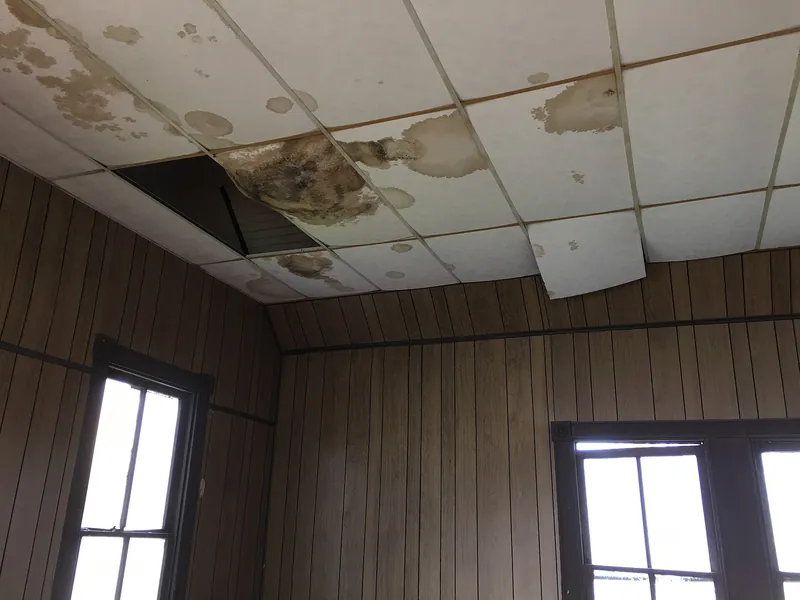
It is an emergency when water is still arriving, when it has touched wiring or a gas appliance, or when it is soaking into drywall, insulation or a subfloor. Delay costs you: mold prevention depends on a 24 to 48 hour drying target, per the EPA.
One drip you caught at once is housekeeping. A supply line that split while nobody was home, and ran for hours, is the real thing.
- A pipe that split in a wall, an attic, a garage or the cabinet under a sink
- A tank-style heater that ruptured, or a loose washer or dishwasher supply hose
- A damp, discolored or drooping ceiling traced to the roof, an air handler or a bathroom above
- A toilet that overflowed, or sewage rising in a tub or floor drain
- Storm runoff coming through a door after a winter downpour
- Several rooms wet, or water that has sat for a full day
What are the first things to do when water is coming in?
Stop the water, make the area electrically safe, then record the scene before anything is moved. After that, phone your insurer and a restoration team. The sequence is the same whether the source is a pipe, an appliance or a roof, and it moves quickly once you have done it.
- Close the source. Use the nearest fixture stop, the water heater inlet or the main shutoff at the house.
- Cut power to the wet area. Do this from dry footing, and go to the panel only when the path to it is dry.
- Move people and pets out of rooms where the water is dirty, deep or near outlets.
- Record everything on video and in photos: the leak, the waterline and every damaged item.
- Tell your insurer. California's insurance department urges homeowners to report water damage immediately.
- Phone a restoration team and describe the source, the wet rooms and the hours the water has been sitting.
- Lift small items off wet floors and slide foil or plastic under furniture feet.
Hold off on tearing out walls or carpet until the photos are done. Triple-I says to keep damaged goods until the adjuster has visited and to postpone major permanent repairs until then.
Where is the water shutoff at an Acton house?
Start with whatever valve is nearest. That could be the stop under a sink or behind a toilet, the cold line into the water heater, or the main shutoff at the house. Past that, a meter box near the road holds the utility's valve, which can need a special tool.
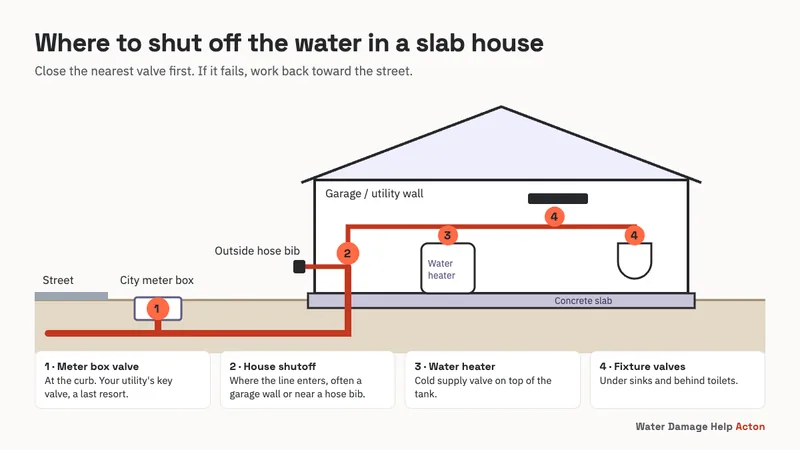
Find these before an emergency, not during one. Layouts vary around Acton, so take one walk past the exterior walls, the garage and the meter box and make notes. If your property is on a well, the shutoff may sit at the pressure tank instead, so ask whoever services the system.
A stuck valve is a job for a plumber, not a pipe wrench. Tell the restoration team the leak is still running. A leak that continues with every fixture off may be underground or beneath a floor, which the slab leak guide explains.
Is it safe to stay home with the power and gas on?
No, not once water has reached outlets, the panel or gas equipment, or when it is deep or dirty. Keep out of the wet zone, kill power from a dry place, and never handle electrical gear while standing in water. Doubtful? Leave and get help.
- Do not run a wet vac, heater or extension cord near standing water.
- A gas water heater or furnace that sat in water needs an inspection before it is relit.
- If you smell gas, go outside and phone the gas utility from there.
- Per Ready.gov, moving water six inches deep can topple an adult and one foot can carry off a car. Stay off flooded roads.
For cleanup after a flood, the CDC recommends rubber boots, gloves and goggles. Ready.gov adds that anyone with asthma, lung disease or a weakened immune system should stay out of buildings that have leaks inside or visible mold.
Is the water clean, grey or sewage?
Restoration providers sort water into three categories under the IICRC S500 standard. The category decides what can be dried where it sits and what has to leave the house. Runoff from outside is the most contaminated class, and it is the one that follows a winter storm.
| Category | Where it comes from | What it tends to mean |
|---|---|---|
| 1, clean | A split supply line or a failed fitting | Materials can often be dried in place if work starts promptly. |
| 2, grey | A washer or dishwasher discharge, or a toilet overflow with no waste | Pad usually comes out, and surfaces are cleaned before drying. |
| 3, grossly contaminated | Sewage, river or stream flooding, surface water from outside | Porous materials the water touched generally go, and workers wear protective gear. |
Time matters too. Clean water that sits for a day or two in a warm house can end up handled like grey water.
Where sewage or other contaminated water is to blame, the EPA recommends a professional with experience in such buildings. The sewage backup cleanup guide covers it in detail.
What if a pipe bursts on a freezing night?
Close the main valve, open a faucet to let pressure out, and turn off power to any wet room. Then photograph the damage and report it to your insurer. Restoration teams differ on night calls, so confirm availability when you phone rather than assuming it.
Cold is a real factor out here. Wikipedia's climate summary for nearby Palmdale counts about 52 mornings a year at or below freezing, with normal lows at or under freezing from late November to late January. The American Red Cross names attics, garages and kitchen cabinets as risky places for supply pipes.
A pipe often reveals its split only when it thaws. If you must warm one, the Red Cross recommends a heating pad, hair dryer or towels soaked in hot water, and warns against a blowtorch, propane heater or any open flame.
Draining the lines and finding the break are covered in the burst pipe guide and the page on thawing a frozen pipe.
What if storm runoff or mud reaches the house?
Safety comes first. Keep everyone out of moving water, stay clear of washed-out roads, and do not go back inside until officials say it is safe. Water that arrives from outside is Category 3, so the cleanup differs sharply from a pipe leak.
The upper branches of the Santa Clara River join into a broad wash near Acton, according to Wikipedia, and Los Angeles County Public Works runs the countywide flood control system. Winter storms can send runoff quickly across dry ground.
Coverage works differently here, too. FEMA says most homeowners policies do not cover flooding, and the California Department of Insurance observes that flood, mudslide and debris flow are usually excluded, except where a recent wildfire is the cause. Read flood cleanup near Acton and flooding after wildfire for the steps.
Should you call a plumber, your insurer or a restoration team first?
Call whoever can stop the water. If you cannot close a valve, that means a plumber. If the water is stopped but the house is wet, phone your insurer and a restoration team about the same time, because the drying clock began when the water did.
| Situation | First call | Next |
|---|---|---|
| Water still flowing and the valve is stuck | A plumber | Your insurer, then a restoration team |
| Flow stopped, floors and walls wet | Your insurer | A provider for extraction and drying |
| Sewage inside the house | A plumber for the line | A provider that handles contaminated water |
| Runoff or mud from outside | Local emergency responders if the scene is unsafe | A flood policy claim, then a provider |
Restoration teams vary in services, availability and price, so ask each one directly.
What should happen over the first two or three days?
Day one should end with the source stopped, standing water out and the damage photographed. On day two, materials that cannot dry should be removed and machines should be running. By day three, readings should be dropping at each visit.
After a flood the CDC names that same 24 to 48 hour window and says soaked carpet and upholstery that cannot be dried quickly should be taken out. Nothing drying by day two? Say so, since it changes what equipment the provider brings.
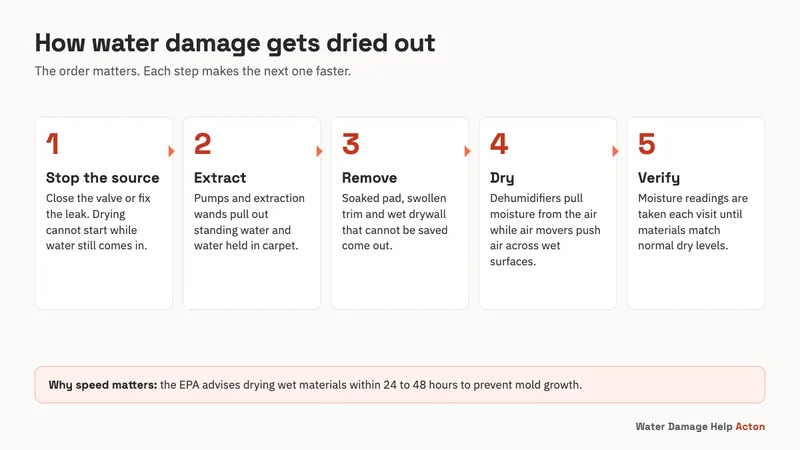
How the work is measured is explained on the water mitigation page and the water removal page.
How do you sign an emergency repair contract safely?
Read every line before signing, even late at night. The state contractors board, CSLB, limits the deposit to the lesser of $1,000 or 10 percent of the price and advises paying only as work gets done. Any change needs a written change order.
There is one catch for urgent jobs. CSLB's guide says the usual right to cancel does not apply to a service and repair contract for emergency work you request on short notice, once it is signed and work begins. So settle the scope and price first.
Questions worth asking are in the restoration company checklist.
Will homeowners insurance pay for emergency water damage?
Usually yes for abrupt plumbing, appliance or roof leaks, and usually no for flood. California's insurance department states that flood is not covered by homeowners policies while other water damage is. NAIC says ground water and rain runoff are typically left out. Your policy text settles it.
On standard forms Triple-I names a sudden discharge or overflow from plumbing, heating, cooling or an appliance as a covered peril. It also notes sewer backup is not in a typical policy and requires an endorsement or its own cover.
Roughly one insured home in 60 files a water or freezing claim yearly, says the Insurance Information Institute. California's rules set two clocks: acknowledgment within 15 calendar days (2695.5(e)), and an accept-or-deny decision 40 calendar days after proof of claim (2695.7(b)).
Trouble opening a claim? The state's consumer hotline is 1-800-927-4357. The insurance claims guide has more, and the restoration cost guide covers pricing.
Sources: California Department of Insurance, Residential Property Claims Guide; California Department of Insurance, February 4, 2025 press release; 10 CCR 2695.5 and 2695.7; Contractors State License Board, home improvement contract guide; EPA, brief guide to mold and moisture; EPA, mold cleanup; CDC, mold and your health; Ready.gov flood guidance; American Red Cross on frozen pipes; IICRC S500 standard; NAIC consumer page on homeowners insurance; FEMA on flood insurance; Triple-I on covered disasters; Triple-I on settling claims; Insurance Information Institute statistics; Wikipedia on Palmdale; Wikipedia on the Santa Clara River; Wikipedia on Los Angeles County.