The short version
In an Acton home, mold appears where materials stay wet, which is why the EPA sets a 24 to 48 hour drying target. A patch under roughly 10 square feet is usually a homeowner job. California does not license mold work, so ask providers what they will do and how they confirm dryness.
How soon does mold start after water damage?
Growth can begin when materials stay wet beyond the first day or two. The EPA sets a target of 24 to 48 hours for drying anything that got wet. California's insurance department (CDI) likewise warns that slow cleanup can lead to mold.
Timing runs from the moment water arrives, long before any stain shows. A supply line seeping inside a wall can leave drywall damp for weeks while the surface looks fine.
After a flood, the CDC makes the same point and adds that soaked carpet and upholstery which cannot be dried promptly should be removed. Early drying costs less than treating a patch afterward, as the restoration cost guide shows.
Does the dry high-desert air keep mold away?
Not once a leak soaks a wall. Acton has warm, dry summers, with no monthly average above 71.6 F, and nearby Palmdale gets only about 5.9 inches of rain in a normal year, according to Wikipedia. Outdoor dryness does little for a pipe leaking inside a cavity.
The California Department of Public Health (CDPH) puts the rule simply in its renter booklet: dampness is needed for mold to grow, so controlling the dampness controls the mold. A closed-up house with a slow leak is a damp place whatever the weather outside.
Winter adds its own risk. Palmdale averages about 52 mornings a year at or below freezing, so a split pipe after a cold night is a realistic source. See burst pipe water damage for that case.
What are the signs of mold after a leak?
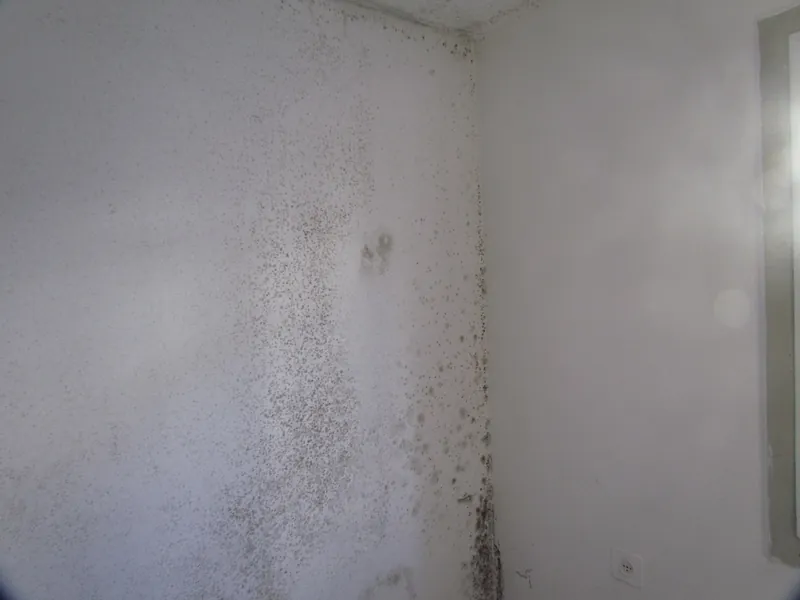
Look for visible growth, a musty odor, stains, peeling paint, warped floors and damp materials. CDPH's renter booklet lists exactly these signs. Color tells you little, since mold can be black, green, white or other shades, and only the cause of the moisture matters for what you do next.
- Visible spots on walls, ceilings, trim or the underside of cabinets.
- A musty smell with no visible cause, often the first hint of growth inside a wall. See water damage smell.
- Stains and peeling paint where water traveled.
- Warped or soft flooring and rotting wood.
- Damp materials that still feel cool or wet days after the leak stopped.
The signs of hidden water damage guide covers the clues that appear before any mold does.

Where does mold hide after a leak?
It hides wherever water soaked in and air could not move. The EPA lists inside walls around leaking or condensing pipes, behind furniture, in ductwork and above ceiling tiles. The table matches those spots to common sources and clues, as a guide rather than a diagnosis.
| Where | Likely water source | What you may notice |
|---|---|---|
| Inside walls | A leaking or sweating pipe, a fixture supply line | Bubbled paint, low stains, a smell with no source |
| Above ceilings | A roof leak or a pipe in the ceiling cavity | Brown rings, drooping drywall, dark patches on tiles |
| Under carpet and flooring | An appliance overflow or a leaking supply line | Lifted seams, cupped boards, a damp feel underfoot |
| Cabinets and vanities | Drain and supply connections, dishwasher hoses | Swollen cabinet floors, warped panels |
| Ductwork and air handler | Condensation or a clogged drain line | A musty smell when the system runs |
Carpet pad holds water below the surface, so see wet carpet drying. For air conditioner leaks, read AC leak water damage. Construction differs from house to house, so treat these as places to check, not predictions.
When can I handle mold myself?
Small patches are usually a do-it-yourself job. The EPA's line is about 10 square feet, roughly a 3 foot by 3 foot square. Bigger areas, mold inside walls and growth linked to sewage or other contaminated water are for a professional.
For hard surfaces, the CDC names three options: a household cleaner, soap and water, or a bleach mix capped at 1 cup per gallon of water. Bleach must never be combined with ammonia or other cleaners. Open the windows and wear boots, gloves and goggles.
Do not paint or caulk over mold, the EPA says, since sealing damp material only hides the problem. Porous things like soaked carpet and ceiling tile often cannot be saved.

Does California license mold remediators?
No. Under CDPH's reading, the state requires no training, license or credential for anyone who assesses or removes mold, and it has no mold inspection or remediation regulations. Some firms hold credentials from national trade groups, which CDPH mentions only as information and does not endorse.
That makes your own questions the main safeguard. Ask what the provider will do, in writing, and how it will confirm the area is dry. A contractor doing building repair work above the licensing threshold still needs a license from the Contractors State License Board (CSLB), which raised that threshold to $1,000 in 2025.
CDPH also says science cannot yet support exposure limits for indoor mold, and California has none. The guide to choosing a restoration company has more questions to ask, and CSLB's license lookup is at cslb.ca.gov.
What should I do first to stop mold from spreading?
Stop the water, then dry and sort what is wet. Speed matters more than the product you choose, since the EPA window is 24 to 48 hours. Put safety first: stay out of standing water near outlets or the breaker box.
- Stop the source. Close the shutoff valve, or switch off the air conditioner if its drain line is overflowing.
- Keep power safe. Do not touch wet electrical equipment, and turn off electricity if that is safe, per Ready.gov.
- Remove what you can lift. Rugs, boxes and soaked furniture go out so the floor can dry.
- Move air and lower humidity. The EPA wants indoor humidity below 60 percent, ideally 30 to 50 percent.
- Measure it. The EPA says a small humidity meter costs $10 to $50 at many hardware stores.
- Photograph before cleanup if you may file a claim, and keep receipts.
Wet drywall, insulation and ceiling tile that stayed soaked usually need to come out. The drywall water damage page explains how that works.
Is mold from water damage a health risk?
For some people it is. Typical effects named by the CDC include congestion, a sore throat, coughing, wheezing, burning eyes and a rash. Severe reactions are possible with asthma or mold allergy, and lung infections can follow in people with weak immune systems or chronic lung disease.
Ready.gov advises people with asthma, lung disease or suppressed immune systems not to enter buildings with indoor leaks or visible mold. Children should not take part in cleanup. Anyone with symptoms should talk to a doctor.
For a quick comparison of mold with mildew, see mold vs mildew. Health effects vary from person to person, so treat any indoor growth as a moisture problem to fix.
Who has to fix mold in a rental?
The owner, when the mold or dampness is a hazard to occupants. Per CDPH, California Health and Safety Code 17920.3 makes a home substandard when dampness or visible mold endangers health, and the owner must fix it. Mold that is minor and on surfaces that normally collect moisture is excluded.
About 12.0 percent of occupied homes in Acton are renter-occupied, according to the 2020 census. Since January 1, 2022, landlords must give prospective tenants a CDPH mold booklet before a lease is signed. Tell the landlord in writing and keep photos.
A code enforcer must cite the condition before the substandard-housing rule applies. Read the renters and landlords guide for notice and repair steps. This is general information, not legal advice.
Does insurance cover mold removal?
Sometimes. Mold that follows a covered peril may be covered under a homeowners policy, CDI explains, and owners should report water damage immediately. Many policies carve mold out, the NAIC cautions, and Triple-I adds that damage from poor maintenance is not covered.
So the cause matters. A sudden pipe break that leads to mold sits differently from a long, ignored drip. Read the mold language in your own policy and ask your agent before work starts.
The insurance claims guide walks through filing. On price, national figures from Bob Vila run $1,100 to $3,400 for removal, averaging $2,200, and Fixr gives $4.75 to $5.50 per square foot. Both are national figures, not Acton quotes.
When should I ask for a restoration team?
Call when the wet area is larger than you can dry in a day or two, when water got into walls or under flooring, or when it came from sewage or flooding. Those are the cases where the EPA says to bring in professionals.
Restoration teams differ, so confirm directly whether one handles mold and how it documents drying. The water removal page and contact page show how to send a request.
Sources: EPA, mold and moisture guide; EPA, cleaning up mold; CDC, About Mold and Your Health; Ready.gov, floods; CDPH, mold questions; CDPH, dampness booklet for renters; CDI, property claims guide; CSLB, release 24-21; NAIC, homeowners insurance; Triple-I, disasters covered; Bob Vila, restoration cost; Fixr, restoration cost; Wikipedia, Acton; Wikipedia, Palmdale.