The short version
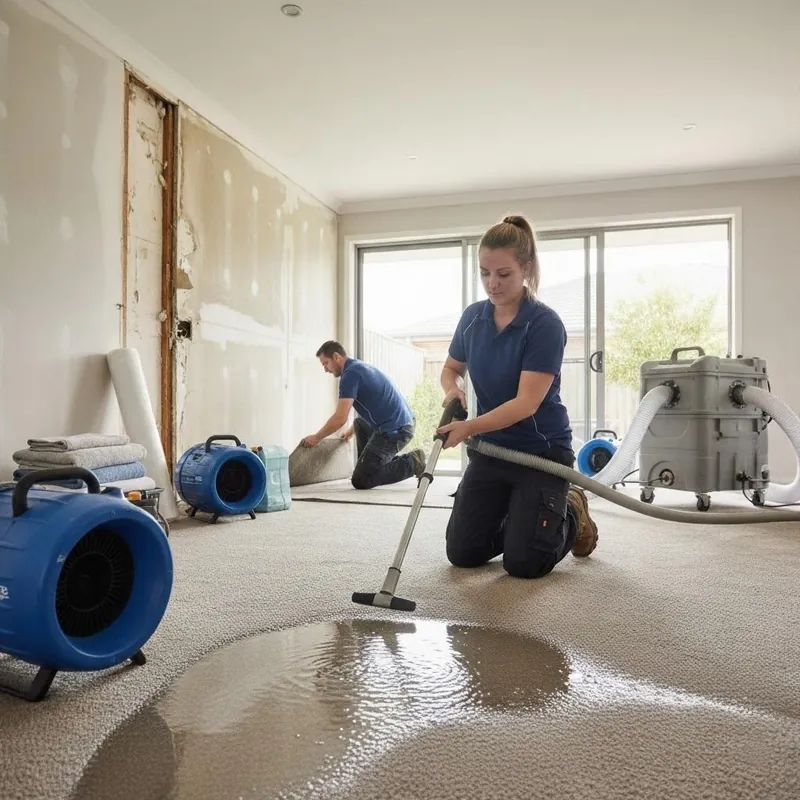
Water damaged floor repair in Acton, CA starts with a closed valve, a cleared surface and moving air. Solid wood hit by clean water often recovers when its subfloor dries too. Laminate seldom does. Flood water ends the debate, since porous flooring goes. Mold risk climbs after 24 to 48 hours, says the EPA.
How do I protect a soaked floor in the first hour?
Stop the water, take weight and moisture traps off the surface, and start moving air. Water damaged floor repair in Acton begins with those small steps, because boards and the subfloor beneath them can stay wet for days after the top looks fine.
- Find and stop the source. Shut the fixture stop or the main valve, or have a plumber deal with the line. Drying cannot start while water keeps coming.
- Switch off the breaker for the wet rooms, but only if you can reach the panel on dry footing.
- Lift rugs, mats and boxes off the floor. Slip foil or plastic under any wood furniture legs that have to stay.
- Photograph the floor before anything is moved, including raised edges, gaps and stains.
- Set up fans and a dehumidifier. Keep space heaters away from the boards, since fast heat can crack and warp them.
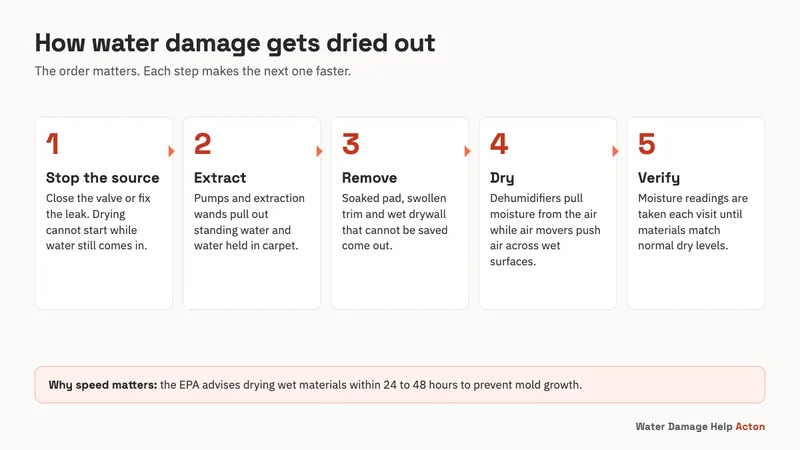
- Phone your insurer, then request a connection to a restoration team. EPA guidance puts the drying window at 24 to 48 hours, because mold becomes likely after that.
Hold off on sanding, sealing or refinishing until the wood is truly dry. If a supply line let go, the shutoff locations are on the burst pipe page, and the overall drying sequence is laid out under water damage repair.
Which floors survive water and which give up?
Material decides. Dense solid wood often dries out when work starts fast, while laminate has a fiberboard core that swells and stays swollen. Tile shrugs water off, although the layers under it may not. Treat the table as a rough sort of the options, not a ruling on your floor.
| Floor type | What water does | Often saved? | Warning signs |
|---|---|---|---|
| Solid hardwood | Boards soak up moisture, then cup or lift | Frequently, if the water was clean and drying began early | Ridges, dark staining, a musty smell that lingers |
| Engineered wood | Glued layers swell apart at the edges | Sometimes, after a light wetting | Bubbling, peeling layers, edges that will not lie flat |
| Laminate | The core puffs at the seams | Seldom, once the core has soaked | Raised seams, crumbly edges, loose planks |
| Vinyl plank or sheet | The surface sheds water; seams admit it | The vinyl often is; its base is the open question | Curling corners, trapped water, odor |
| Ceramic or stone tile | Water seeps down through the grout | The tile usually is; the bed below needs a check | Hollow sound when tapped, cracked grout, a soft base |
A provider should read moisture in the surface and in the layers below before anyone says what stays. Carpet gets its own treatment on the wet carpet drying page.
What do cupped, crowned and buckled boards tell me?
They describe how far a wood floor has moved, and they hint at where the water came from. Cupping means board edges sit higher than the middle. Crowning is the reverse. Buckling is the most severe, with boards pushing up off the subfloor.
- Cupped: the underside took on more moisture than the top. Think of a slow supply-line drip or a damp area below the floor.
- Crowned: the top got wetter, or a cupped floor was sanded while still damp and then dried flat in the middle.
- Buckled: the whole floor swelled until it lifted, which usually follows a large volume of water or a long soaking.
Mild cupping can ease as a floor dries slowly and evenly. Buckled boards rarely go back down. Wait for dry readings before choosing between sanding and replacing.
Can solid wood be saved after a leak?
Often yes, when the water was clean, the response was quick and the subfloor can dry as well. Dense hardwood takes in water slowly and gives it back slowly, so there is a window to act. Waiting turns a repair into a replacement.
The odds drop if water sat for days, picked up dirt, or crept in from below for weeks. Black staining, an odor that will not fade and boards lifting from the subfloor all point toward replacement. Readings across the boards show which case you have. Not every provider handles wood the same way, so ask whether yours dries boards where they lie or tears them out.
Should I try drying a wood floor myself?
For a small clean spill you catch right away, yes. Mop or vacuum up the water, run fans and a dehumidifier, and watch the boards for lifting over the next several days. Anything larger needs equipment and readings, not a box fan and a guess.
Drying mats or panels pull moisture up through the wood, and dehumidifiers and air movers handle the room. A provider records readings on the boards and the subfloor and keeps equipment running until those numbers level off. Fingers cannot tell, since a dry-feeling surface can sit on a wet layer.
Drying does not always mean tearing up the floor. Sometimes a few boards along one wall come out to open a path for air. Equipment is described on the structural drying page.
Why do laminate floors fail so quickly?
Laminate is a thin printed layer over compressed fiberboard, and that board swells when it is wet and does not shrink back. A fast wipe-up of a spill may do no harm. Water that reaches the seams usually does, and the damage is permanent.
Look for raised seams, crumbling edges and planks that have stopped clicking together. If only a few planks are hurt, those can sometimes be swapped, provided a matching style is still sold. Laminate floats over an underlayment, so lift an edge and check whether water is trapped against the subfloor below.
Are vinyl plank and tile safe after a leak?
The surface usually survives, and the layer beneath is the worry. Neither vinyl nor tile absorbs water, but water slides through seams and grout lines and settles on the base underneath, where damage and mold can start out of sight for weeks.
- Vinyl plank and sheet vinyl: turned-up corners, pooled water, odor or a squishy base mean the vinyl likely lifts so the base can dry.
- Tile: tap a few. A hollow ring, split grout or a mushy bed suggests water reached what lies below.
A floor can look flawless and still feel spongy or smell musty. Believe the meter over your eyes. When odor is your only clue, the water damage smell page can point you to the source.
How does water hide under a floor?
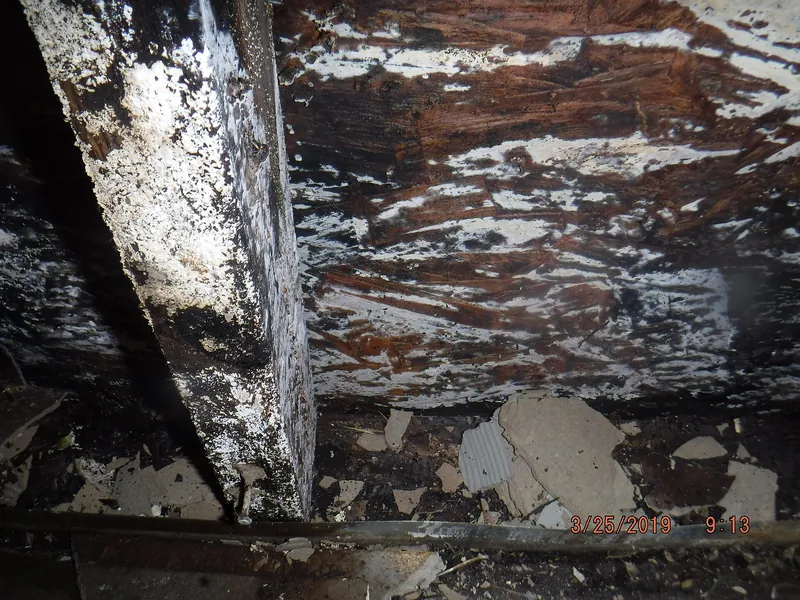
It travels along seams and walls, drops under the flooring and stays between layers where air cannot reach. That is why floors that look dry cup or smell weeks later. The subfloor, plywood or boards under the finish floor, is usually where the trouble sits.
Warning signs include a soft or spongy step, boards that begin to cup after the top has dried, baseboards that stay damp and a smell you cannot trace. Plywood and OSB lose strength when they stay wet. To reach them, a provider may lift a few boards or drill small holes and use specialty drying gear.

Do not assume what sits under your floor, since nothing documents Acton homes as a type. Ask the provider to look, and see how wet-room leaks spread on the bathroom and kitchen page.
What if a winter freeze split a pipe above the floor?
A frozen supply line can crack and then leak hard once it thaws, soaking floors in a short time. Acton's neighbor Palmdale averages 52 mornings a year at or below freezing, per Wikipedia's climate summary, so cold snaps are a real source of floor damage here.
Supply pipes in unheated spots such as attics, garages, crawl spaces and kitchen cabinets face the most risk, the American Red Cross says. Its advice for time away: heat no lower than 55 F, plus a cold drip from faucets on exposed pipes.
If you find a wet floor after a freeze, shut the main valve first. Steps for thawing and for finding the split are on the frozen pipes page. Photograph the floor before the water is cleared, because an adjuster will ask for it.
What if storm runoff or flood water reached the floor?
Assume it is contaminated and expect porous flooring to come out. The IICRC S500 standard places rising flood water and outside surface water in Category 3, grossly contaminated. Wood, laminate and anything with padding that it touched usually cannot be made safe by cleaning.
For this kind of loss the EPA points owners to a professional with contaminated-water experience. The CDC recommends boots, gloves and goggles, and warns never to mix bleach with ammonia.
Acton sits where the upper branches of the Santa Clara River gather into a wide wash, according to Wikipedia. That is a reason to learn how your property drains, not a claim about any one house. After a burn, mud and debris can reach a floor even when the rain is modest, covered in flooding after wildfire. Standard policies exclude flood, so read flood cleanup before you discard anything.
When is replacing cheaper than drying?
Replacement makes sense when the material cannot return to a flat, stable shape, or when the water was dirty. Drying deserves a try if the water was clean, work began early and the floor is solid wood or something similarly tolerant.
| Situation | Usual direction |
|---|---|
| Clean water, fast start, solid hardwood | Try drying, then check that boards lie flat |
| Weeks of dampness from below, dark staining | Expect replacement and a subfloor inspection |
| Laminate with swollen seams | Replace the damaged run |
| Sewage or flood water on the floor | Porous flooring comes out; see sewage backup cleanup |
Some dried floors take a sanding and a new finish, though only once the readings show dry wood. A finish applied too soon seals moisture in and invites crowning.
What does floor repair cost, and who does the work?
Price moves with the floor type, the area and the state of the subfloor. Fixr lists hardwood restoration at $10 to $15 per square foot nationally. Bob Vila, citing Angi and HomeAdvisor, gives $200 to $500 to restore floors. Both are national, so neither is an Acton quote.
Providers set their own prices, so ask for itemized written bids. On licensing, the Contractors State License Board says a project under $1,000 may go unlicensed in California from 2025, but only without hired workers or permits. Acton is unincorporated, which means Los Angeles County issues building permits. The repair permits page explains when one is needed, and restoration cost shows how a bill is built.
Does insurance pay for a damaged floor in California?
Typically yes for a sudden plumbing or appliance failure, and no for flood. The California Department of Insurance states that homeowners policies leave out flood but cover other kinds of water damage. Triple-I adds that neglected maintenance is not covered.
California puts clocks on insurers. Section 2695.5 of Title 10 requires acknowledging a claim within 15 calendar days. Section 2695.7 gives 40 calendar days after proof of claim to accept or deny. Denials must be written and mention review by the Department.
The Department's consumer hotline is 1-800-927-4357. Triple-I suggests photographing everything and delaying major permanent repairs until the adjuster has looked. More steps sit in the insurance claims guide.
Sources: CDI residential property claims guide; 10 CCR 2695.5; 10 CCR 2695.7; CSLB press release on the handyperson limit; Red Cross frozen pipes page; Wikipedia on Palmdale; Wikipedia on the Santa Clara River; EPA moisture guide; EPA cleanup page; CDC mold page; IICRC S500 overview; Fixr cost guide; Bob Vila cost guide; Triple-I on covered disasters; Triple-I on settling claims.