The short version
To thaw frozen pipes, keep the faucet open and warm the pipe with a heating pad, hair dryer, space heater kept away from flammables or hot towels. Never use an open flame. Check other faucets, and call a plumber if you cannot find or thaw the ice. If the pipe split, shut off the water and dry the area in 24 to 48 hours.
How do I know a pipe in my Acton home is frozen?
If you open a faucet and only a trickle comes out, suspect a frozen pipe. The American Red Cross says the likely spots are along exterior walls and where the water service enters the house. Knowing how to thaw frozen pipes starts with confirming which line is blocked.
Cold in this part of Los Angeles County is a real winter issue. Wikipedia's climate summary for nearby Palmdale gives about 52 mornings a year at or below freezing, with normal daily lows at or below freezing from late November to late January. Acton sits close by, so plan for cold nights from late fall on.
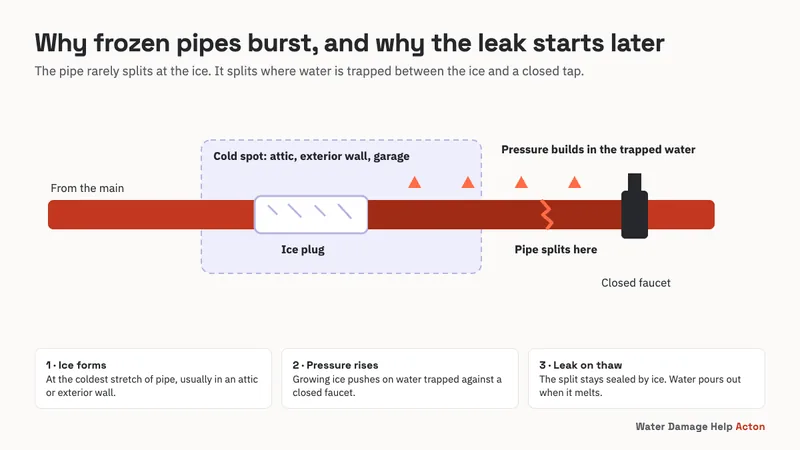
The Red Cross explains why freezing does damage: water expands as it freezes, and that puts tremendous pressure on whatever holds it, metal or plastic. Even a strong pipe can break. A pipe that is only frozen is a nuisance. A pipe that has split is a flood waiting for the ice to melt.
What are the steps to thaw a frozen pipe safely?
Keep the faucet open, apply gentle heat to the frozen section and keep going until full water pressure returns. The Red Cross lists the safe heat sources. Work from the faucet back toward the blockage so melting water has somewhere to go.
- Leave the faucet open. The Red Cross says running water through the pipe helps melt the ice as the frozen area starts to thaw.
- Find the cold section. Check exterior walls and the spot where the water line enters the house first.
- Apply gentle heat. Use an electric heating pad wrapped around the pipe, a hair dryer, a portable space heater kept away from flammable materials, or towels soaked in hot water.
- Keep heating until pressure is full. The Red Cross says to apply heat until full water pressure is restored.
- Check every other faucet. If one pipe froze, the Red Cross warns that others may have frozen too.
- Call a plumber if it will not budge. That applies when you cannot find the frozen spot, cannot reach it or cannot thaw it.
Keep cords and heaters away from standing water. Ready.gov's flood advice is not to touch wet electrical equipment or stand in water, and the same caution fits a leaking pipe.
What should I never use to thaw a frozen pipe?
Never use an open flame. The Red Cross says no blowtorch, kerosene heater, propane heater, charcoal stove or other open flame device. Pipes sit next to wood framing, insulation and wiring, so a flame can start a fire long before it clears the ice.
| Heat source | Red Cross guidance | Keep in mind |
|---|---|---|
| Electric heating pad | Listed as safe, wrapped around the pipe | Plug it in away from any wet floor |
| Hair dryer | Listed as safe | Move it slowly along the pipe |
| Portable space heater | Safe if kept away from flammable materials | Never leave it running unattended |
| Towels soaked in hot water | Listed as safe, wrapped around the pipe | Re-soak them as they cool |
| Blowtorch, propane or kerosene heater, charcoal stove | Do not use | Open flame near framing is a fire risk |
The Red Cross advice is the same whether the pipe is in a wall, a garage or under a cabinet. If you cannot reach the frozen section with a safe heat source, stop and call a plumber instead of improvising.
Which pipes freeze first in an Acton house?
Pipes with the least protection freeze first. The Red Cross names three groups: lines exposed to severe cold outdoors, supply pipes in unheated interior spaces, and pipes along exterior walls with little or no insulation. Which of these your property has depends on how it was built.
- Outdoor lines: hose bibs, swimming pool supply lines and sprinkler lines. Check your own yard for any of them.
- Unheated interior spaces: attics, garages and kitchen cabinets, plus crawl spaces if your property has them.
- Exterior walls: any supply line run against an outside wall with thin insulation.
Walk the house once before the first cold snap and note where each supply line runs. If your property is on a well or has a pump house, ask the person who installed it how the pipes there are protected.
What if the frozen pipe has already burst?
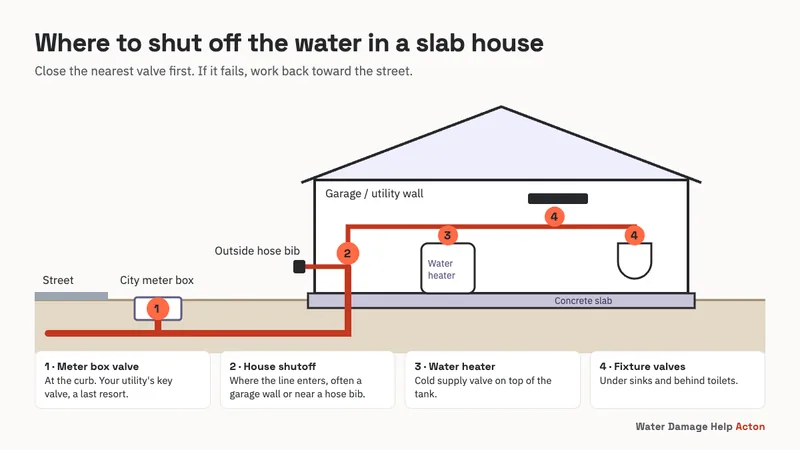
Close the house shutoff valve, then open a faucet at the lowest point to drain the line. A burst pipe is clean supply water, which IICRC S500 calls Category 1, but it soaks drywall and flooring fast. Start drying as soon as the water is stopped.
Mold needs time, and the EPA puts the clock at the first 24 to 48 hours of drying. California's insurance regulator adds that you should hunt down the source of any leak right away, because waiting lets mold take hold.
Take photos of the split pipe, the wet areas and anything damaged before you move it. Our burst pipe page covers the first hour in detail, and the emergency water damage restoration page explains what drying involves.
How do I keep pipes from freezing on cold Antelope Valley nights?
Let cold water drip, open cabinet doors and keep the thermostat steady. The Red Cross lists these as the quick measures when the forecast turns hard. They cost little compared with a split pipe and the drying that follows.
- Let cold water drip from faucets fed by exposed pipes. Even a trickle keeps water moving.
- Open kitchen and bathroom cabinet doors so warmer air reaches the plumbing, and move chemicals out of children's reach.
- Keep the thermostat at the same setting day and night.
- Keep garage doors closed if supply lines run through the garage.
- Traveling in winter? Leave the heat on, set to 55 F or higher.
Before winter, the Red Cross also says to drain and store hoses, close the inside valves feeding outdoor hose bibs, open the outside bibs to drain, and insulate pipes in unheated spaces with pipe sleeves or UL-listed heat tape. The prevention guide adds the rest of the seasonal checklist.
Does insurance cover a pipe that freezes and bursts in California?
Often it does, but read your policy before you count on it. Triple-I lists plumbing discharge and the freezing of plumbing among the perils named on standard forms. The same source notes that neglected upkeep is excluded, so insulating exposed pipes also helps a claim.
Tell your agent or insurer about water damage at once, as the state insurance department urges. California's claim regulations then set the pace: acknowledgment inside fifteen calendar days (10 CCR 2695.5(e)), and an accept or deny decision inside forty calendar days after proof of claim (2695.7(b)).
Triple-I's advice is to limit further damage, keep receipts, photograph the loss and wait on large permanent repairs until the adjuster visits. Our insurance claims guide walks through the order of steps. If a claim goes badly, the California Department of Insurance takes complaints at 1-800-927-4357.
When should I call a plumber or a restoration team?
Call a plumber when you cannot find, reach or thaw the frozen section, and call a restoration team once water has spread. A plumber fixes the pipe. A restoration team dries the building. They are different jobs, and a split pipe usually needs both.
Restoration teams set their own terms, services and availability, so confirm directly what a company handles before you agree to anything. Ask for moisture readings and photos of the wet areas.
The guide index lists every Acton topic, and the water removal page explains the first stage of drying.
Sources: Red Cross frozen pipes page; Palmdale on Wikipedia; Ready.gov floods page; IICRC S500 standard; EPA mold and moisture guide; state insurance department claims guide; Triple-I on covered perils; Triple-I on settling claims; 10 CCR 2695.5 and 2695.7.